


 English
 Español


How Floor Load Capacity Determines Your Racking Layout
Before selecting any racking system, the structural load-bearing capacity of the warehouse floor must be assessed — not just noted, but used as an active constraint in system design. Most standard industrial concrete floors support between 3,000 and 6,000 kg per square meter, but this figure is rarely uniform across the entire slab. Areas near expansion joints, drainage channels, or older repair patches may have significantly reduced capacity. Ignoring these variations leads to uneven settlement, rack tilt, and — in worst cases — catastrophic collapse.
The critical calculation is converting the total load of a fully loaded rack bay into point loads at each anchor position. A double-deep pallet racking system storing 1,500 kg pallets on five levels, for example, concentrates forces on just four baseplate footprints. If those baseplates are small and the floor is weak, the concentrated pressure per cm² can easily exceed safe limits even when the "total floor load" appears fine on paper. Spreading baseplates, using seismic floor anchors, or installing load-distribution steel plates beneath uprights are common engineering solutions when floor strength is marginal.
At Huijian, our engineering team conducts on-site floor surveys as part of every large project, treating floor data as a non-negotiable input rather than an afterthought. This prevents costly retrofitting after installation.
The Real Differences Between Selective, Drive-In, and Shuttle Racking
These three racking types are frequently conflated, but they represent fundamentally different inventory access philosophies and suit very different operational models.
| Type | Access Mode | Space Utilization | Best For | Key Limitation |
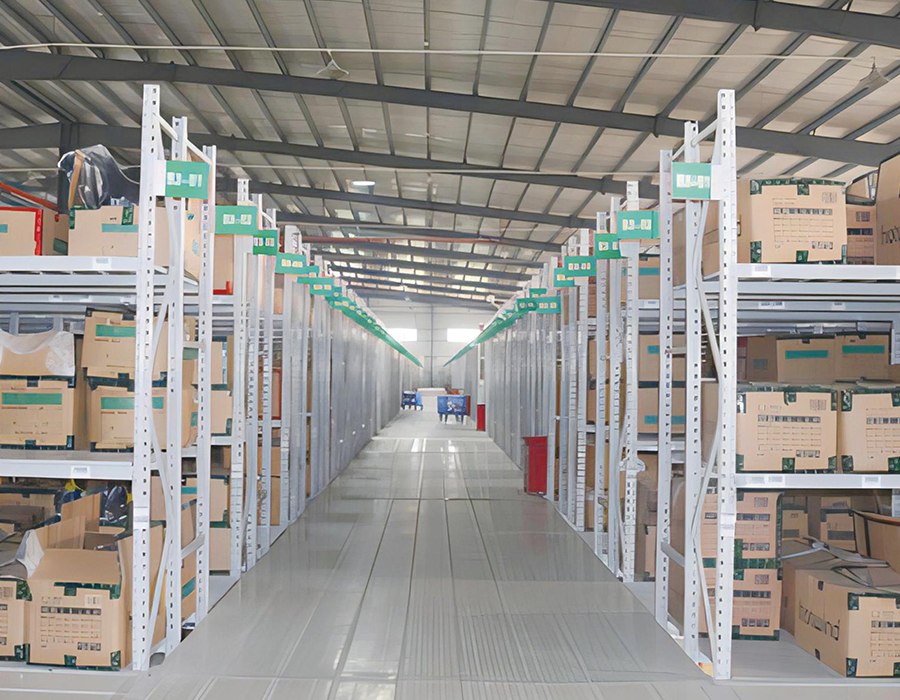
| Selective Pallet Racking | Direct access to every pallet | ~40–50% | High SKU diversity, frequent picks | Low storage density |
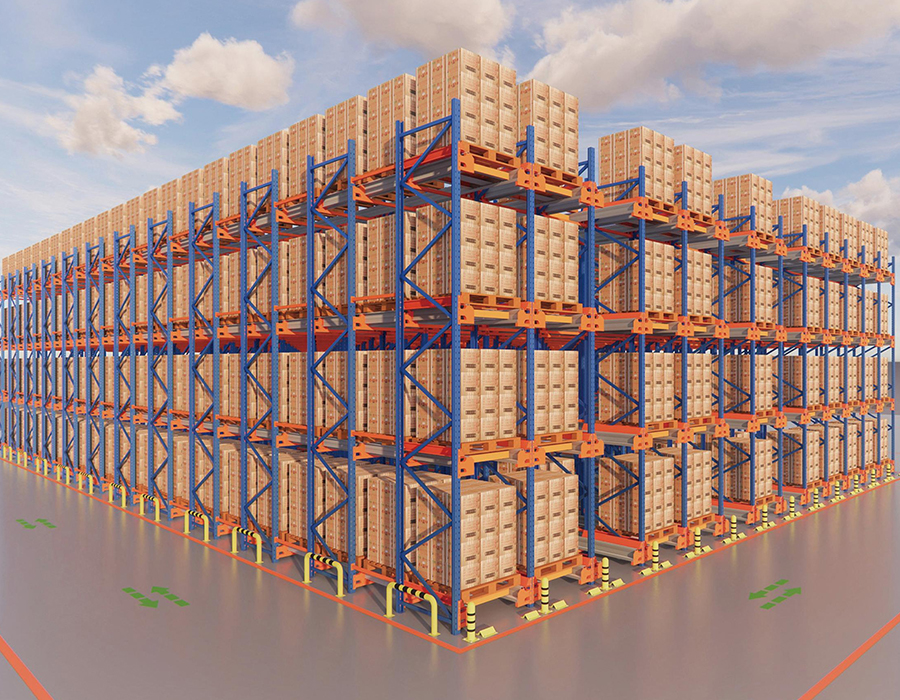
| Drive-In Racking | LIFO — forklift enters lanes | ~75–85% | Bulk storage, low SKU count, stable inventory | No individual pallet access; FIFO requires drive-through |
| Shuttle Racking | Semi-automated FIFO or LIFO via motorized shuttle | ~85–90% | Cold storage, high-volume same-SKU operations | Higher upfront cost; dependent on shuttle battery/maintenance |
Drive-in racking's hidden weakness is lane discipline: when forklifts slightly misalign during entry, upright damage accumulates rapidly. Shuttle racking eliminates this by removing the forklift from the lane entirely — the motorized cart handles all internal movement, drastically reducing rack damage rates. For cold storage operations where labor costs and door-open times are critical, shuttle systems typically pay back within two to three years despite higher initial investment.
Why Column Spacing in Mezzanine Floors Affects More Than Headroom
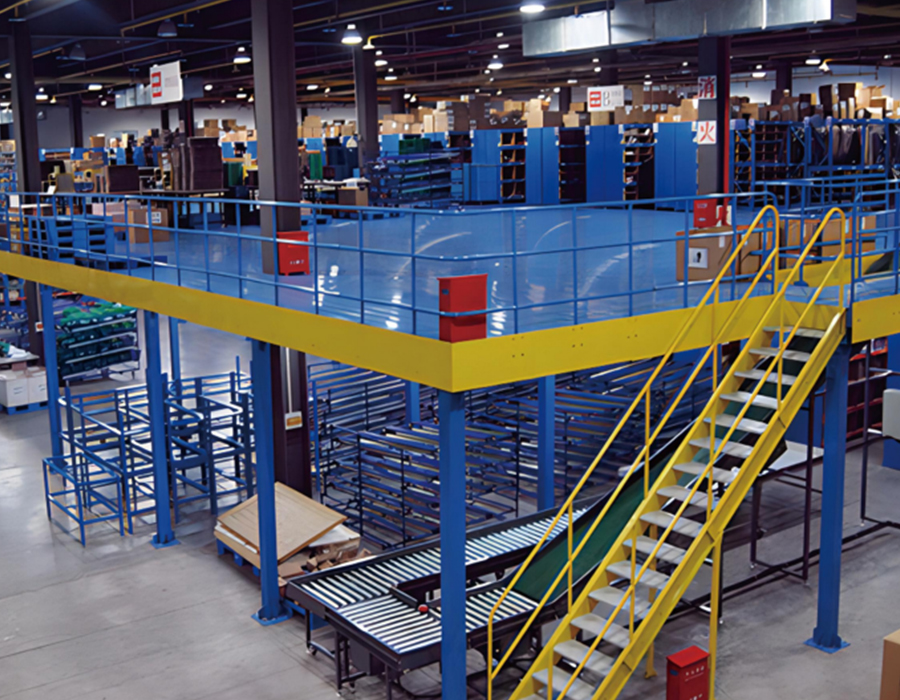
Mezzanine flooring systems in warehouses are often evaluated primarily on load capacity and headroom, but column grid spacing has a less obvious yet profound effect on operational flexibility. Narrower column grids (e.g., 2m × 2m) allow lighter structural steel and lower cost, but they fragment the floor plan below, creating obstacles for forklifts, conveyor routing, and future reconfiguration. Wider grids (e.g., 6m × 6m) require heavier beams and higher steel cost but deliver open, unobstructed zones beneath the mezzanine that can accommodate full pallet racking aisles.
The decision is not purely structural — it must be integrated with the material flow plan. If the space beneath the mezzanine will house automation equipment or wide-aisle racking, designing a 4m or wider column grid from the start avoids expensive structural modifications later. Decking material also matters: steel grating allows light and air circulation but can drop small items; resin-bonded particle board decking creates a solid, load-spreading surface but requires more attention to moisture in humid environments.
Seismic Zone Classification and Its Practical Impact on Rack Specification
China's national standard GB 50011 divides regions into seismic intensity zones from VI to IX, and warehouse racking in zones VII and above must meet specific bracing, anchor, and material requirements that are meaningfully different from standard specifications. Many buyers outside earthquake-prone regions underestimate this, but facilities in parts of Yunnan, Sichuan, Xinjiang, and coastal zones face real seismic risk that requires engineered solutions.
Practically, seismic compliance changes racking design in several ways:
- Upright frames require additional diagonal bracing members, increasing frame weight and reducing the clear width available for load-bearing beams at lower levels.
- Base anchors must be embedded at certified depths in concrete of a specified minimum compressive strength — post-installed chemical anchors are acceptable in most zones but must be pull-tested to verified loads.
- Row spacers and spine bracing connecting adjacent rows become mandatory above certain heights, distributing lateral loads across the rack system rather than concentrating them at individual anchor points.
- The maximum permissible height-to-depth ratio of the rack system is reduced, which may necessitate wider base frames or lower storage heights in extreme seismic zones.
Specifying racks to standard (non-seismic) tolerances in a Zone VIII area is not only a compliance risk but a liability risk. Our intelligent warehouse storage racking solutions are engineered with seismic zone data integrated at the design stage, not added as a checkbox after the fact.
Steel Grade Selection: Q235 vs. Q345 and When the Difference Matters
Q235 and Q345 are the two most common structural steels used in Chinese warehouse racking production, and the choice between them is frequently misunderstood. The yield strength of Q345 (345 MPa) is approximately 47% higher than Q235 (235 MPa), which means that for the same cross-section, Q345 components carry more load. However, the meaningful question is not "which is stronger" but "which is appropriate for the specified load at the given cross-section geometry."
For standard-height selective racking (under 6m) carrying normal pallet loads, Q235 cold-rolled sections of adequate gauge perform reliably and offer cost efficiency. Where Q345 delivers clear advantages is in high-bay racking above 8m, heavily loaded drive-in systems, and mezzanine structural members where deflection control under sustained load becomes critical. Using Q345 to reduce section thickness while maintaining load rating is a legitimate engineering approach — but requires careful verification that the thinner section does not compromise local buckling resistance in compressed upright columns.
Buyers evaluating racking quotes should request the steel grade certification and the section thickness alongside the load table, not just the rated capacity figure. A high rated capacity achieved through material grade can be appropriate; one achieved through unverified assumptions about section behavior is not.
Understanding Rack Damage: How to Classify It and When to Replace
Rack damage from forklift impacts is the most common cause of warehouse racking failures, yet many facilities have no formal damage classification or inspection protocol. The European standard EN 15635 and China's equivalent guidance both recognize a risk-based approach to damage assessment that divides deformations into three action levels.
Green (Acceptable — Monitor)
Minor surface damage, paint loss, or very small dents that do not affect the cross-sectional geometry of the upright. No load reduction required, but the damage should be logged and re-inspected on the next scheduled cycle.
Amber (Load Reduction Required — Schedule Repair)
Visible deformation of the upright flange or web, including bowing, twisting, or indentation exceeding defined limits (typically 3mm lateral deflection per 1m of upright height). The bay must be off-loaded or load reduced until the damaged component is replaced. Using a rack protector or column guard as a substitute for replacement is not acceptable at this level.
Red (Immediate Unloading and Isolation)
Cracking, tearing, severe buckling, or any damage to weld zones. The bay must be immediately unloaded and cordoned off regardless of how the rack appears to be behaving under current load. Racks can carry loads past visible yield up to the point of sudden collapse.
As a warehouse shelving suppliers with our own production lines and R&D capabilities, we are able to supply certified replacement uprights and beams that are dimensionally matched to installed systems — a practical advantage when urgent repairs are needed without full system replacement.
Optimizing Beam Level Heights for Mixed-SKU Pallets
One of the most overlooked efficiency levers in warehouse racking configuration is beam pitch — the vertical spacing between beam levels. Many facilities set a uniform beam pitch across all bays based on the tallest pallet in the inventory, wasting significant vertical space wherever shorter pallets are stored. A more disciplined approach involves segmenting the warehouse into product-height zones and configuring beam pitches accordingly.
A practical method is to build a pallet height distribution table from inventory data and identify the three or four dominant height bands. Bays dedicated to each band are then configured with beam pitches sized to that band plus a handling clearance of 100–150mm. The cumulative space recovered can be substantial: in a 10m-high bay, shifting from a uniform 2,000mm pitch (four beam levels) to a 1,350mm pitch for a short-goods zone yields five beam levels — a 25% increase in pallet positions within the same footprint.
The constraint is operational: mixed-height zones require either strict slotting discipline or a warehouse management system (WMS) that enforces height-aware location assignment. Without this, short pallets inevitably drift into tall-pitch bays, and the efficiency gain evaporates. Beam adjustment is straightforward in standard boltless racking — beams relocate within minutes — but the organizational discipline to maintain zone integrity is the harder requirement to sustain.
What "Intelligent" Actually Means in Modern Warehouse Storage Racking Systems
The term "intelligent warehouse storage racking solutions" is applied broadly across the industry, but the underlying technologies vary enormously in maturity and practical value. It is worth distinguishing between the layers of intelligence that are currently commercially proven versus those that remain aspirational in most deployments.
- Sensor-based load monitoring embeds strain gauges or load cells into rack uprights or beam connections, providing real-time weight data to a central monitoring system. This is mature technology with clear safety and inventory management benefits — overloading events trigger alerts before structural limits are reached.
- Automated storage and retrieval systems (AS/RS) integrated with racking — including stacker cranes, miniload systems, and autonomous mobile robots (AMRs) operating in rack aisles — represent proven, high-investment intelligent infrastructure. These are appropriate for high-throughput, predictable-SKU environments rather than general warehousing.
- RFID and barcode location verification at the rack-face level provides pick confirmation and real-time location accuracy within the WMS. This is inexpensive, widely deployed, and genuinely improves inventory accuracy when correctly installed.
- Predictive maintenance via vibration analysis on shuttle vehicles, cranes, and conveyor systems connected to racking infrastructure is an emerging application — useful in high-utilization automated environments but generating more noise than signal in manually operated warehouses.
At Huijian, our intelligent racking product line is developed through our 1,500-square-meter R&D center and designed to integrate with real operational systems — not to market a label. The goal is always to match the right level of intelligence to the actual throughput, SKU profile, and automation readiness of each customer's operation.