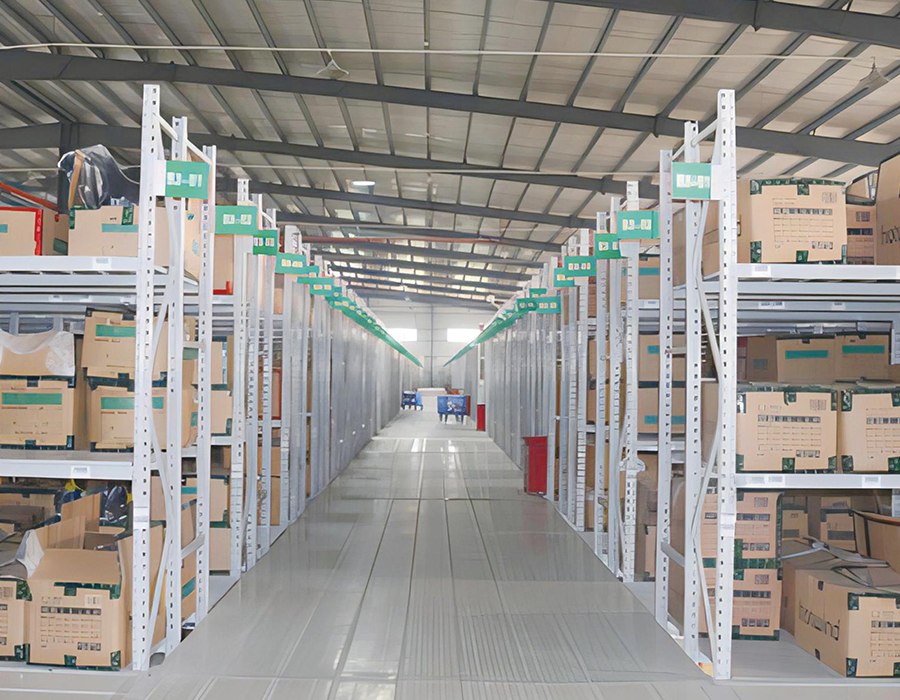
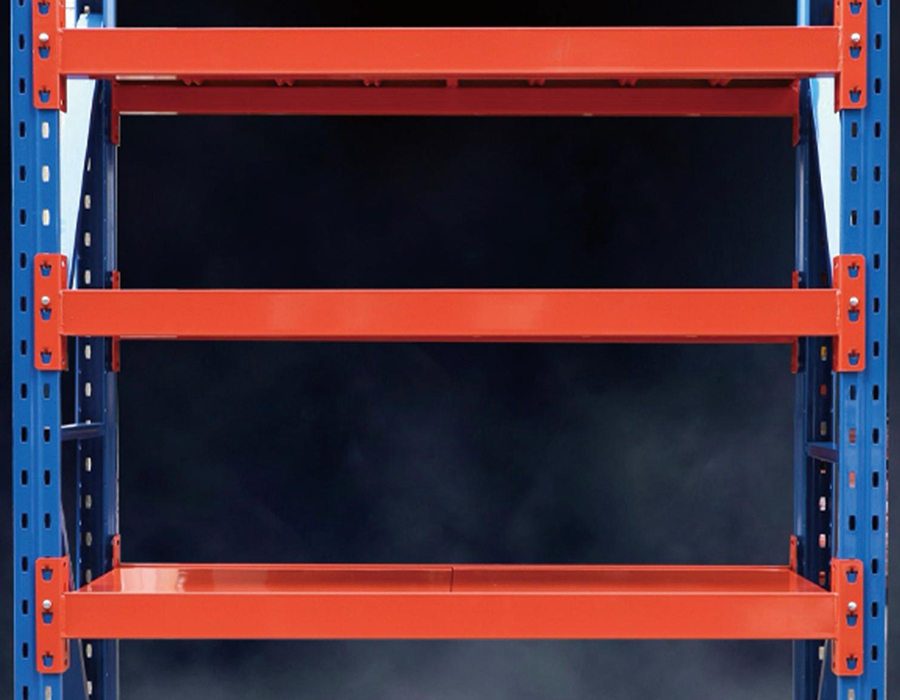
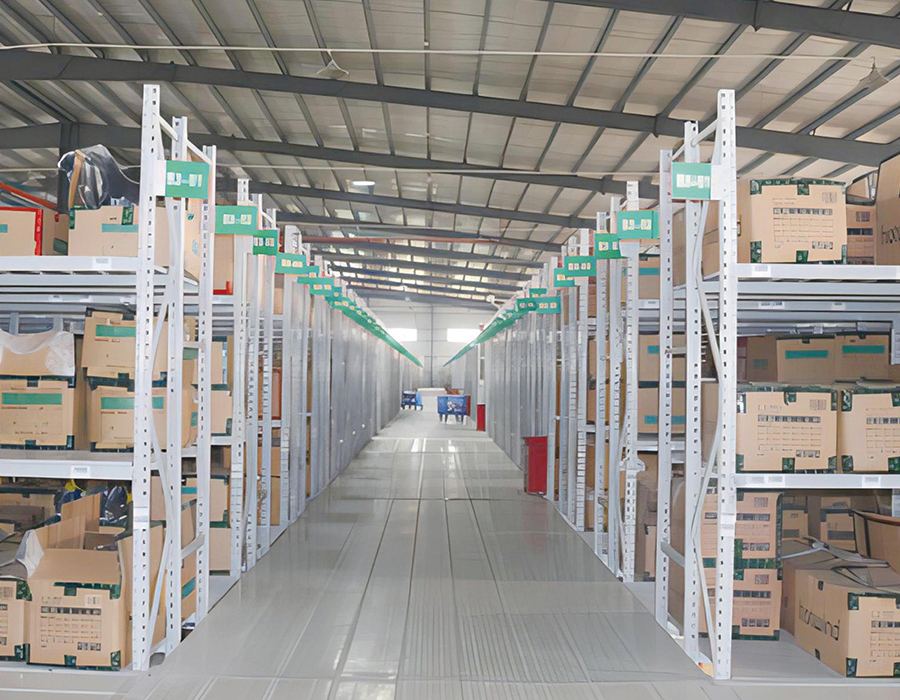
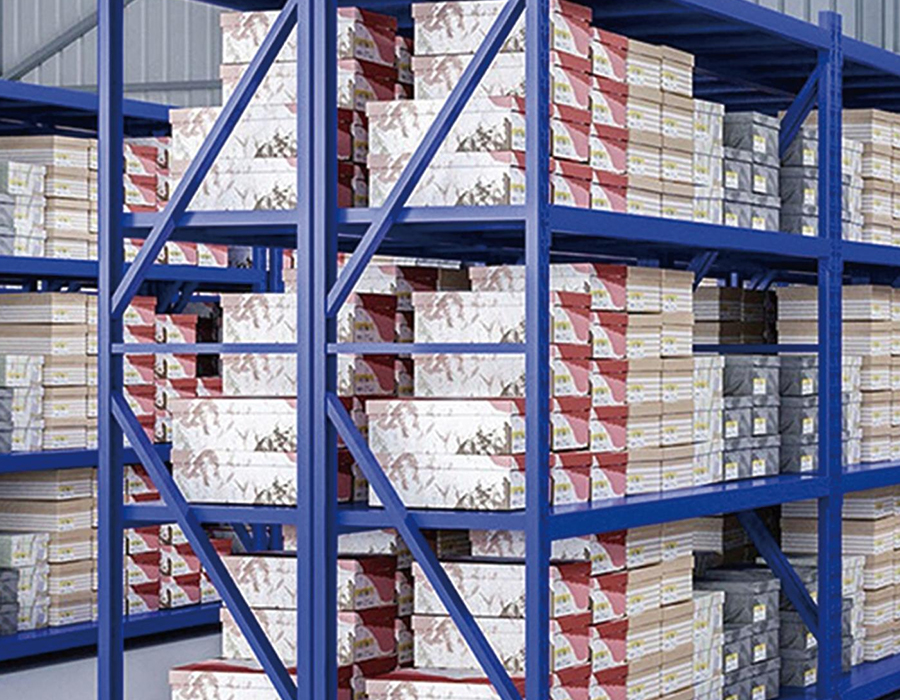
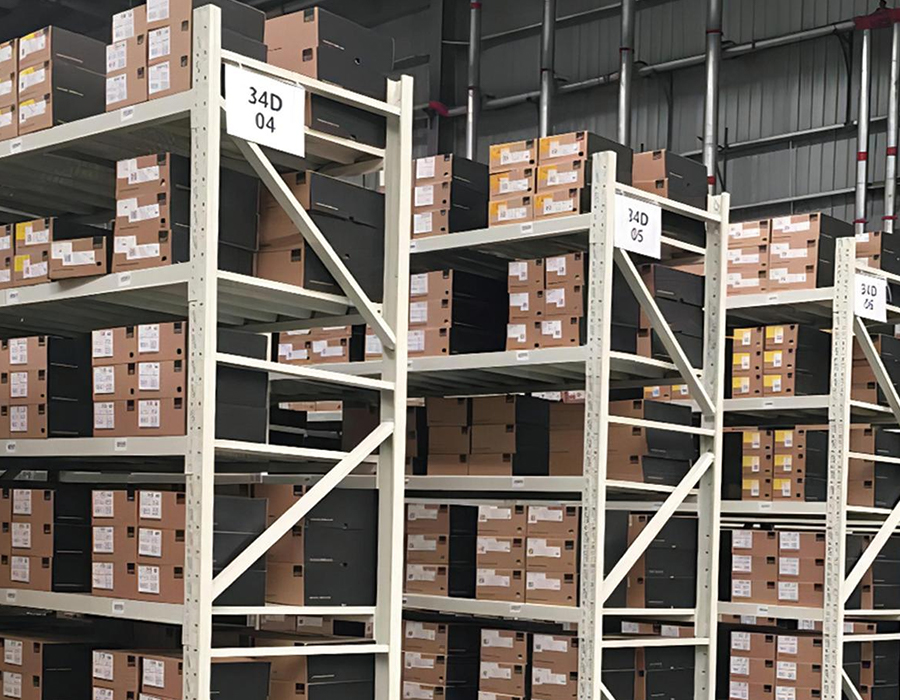
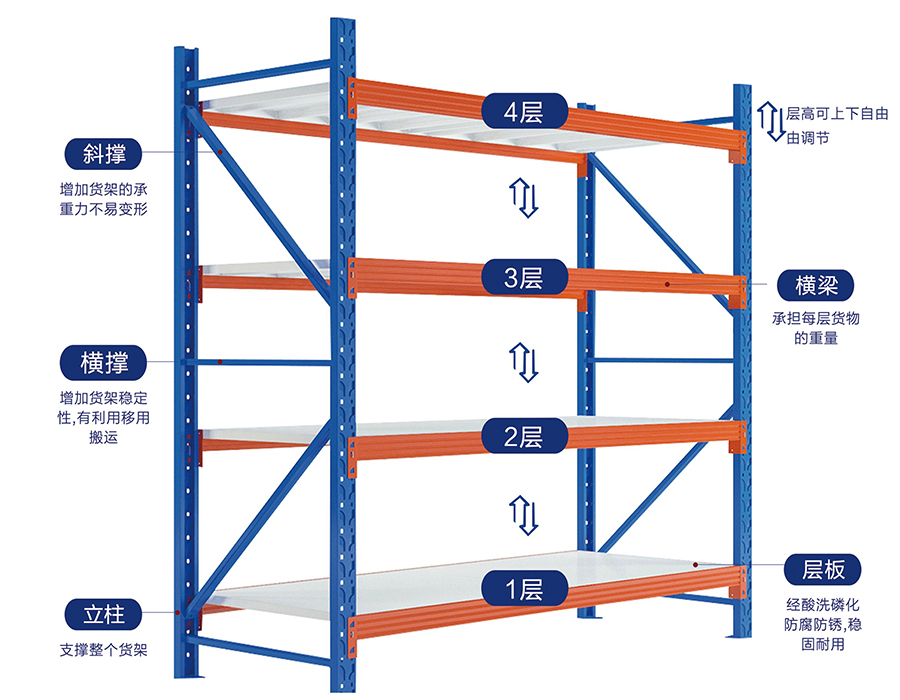
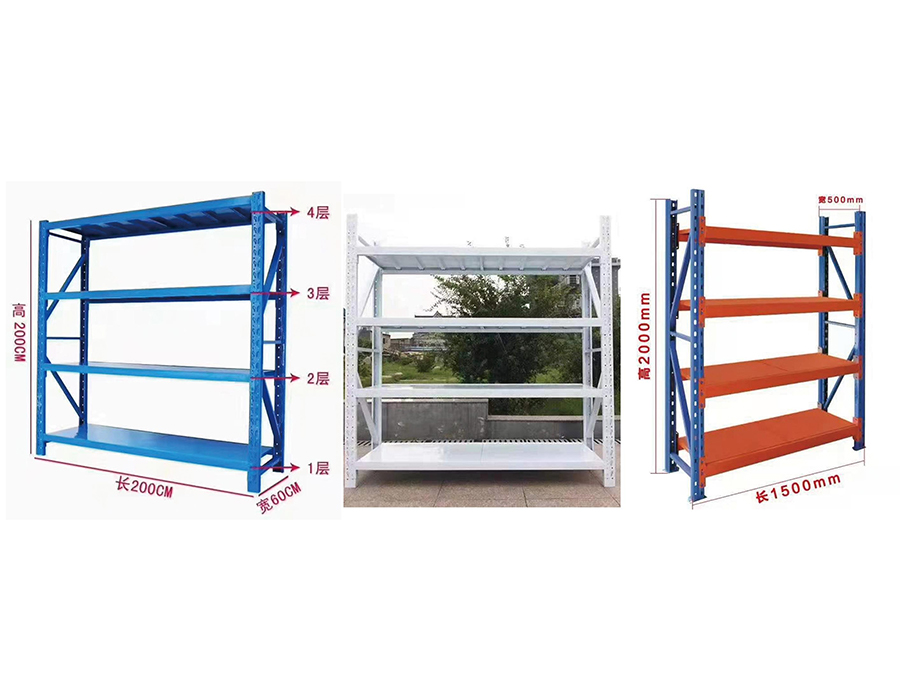
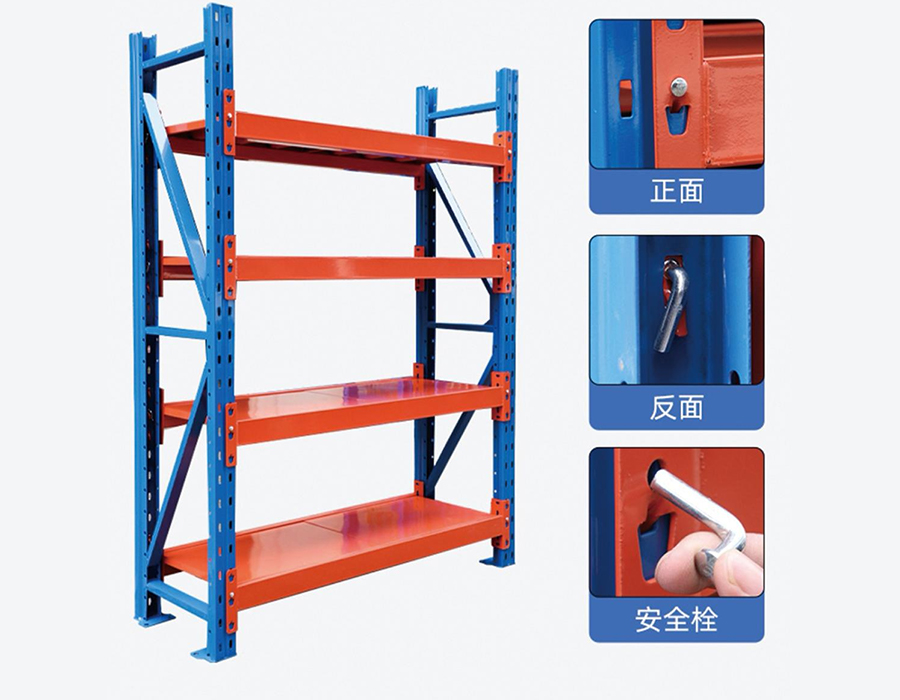
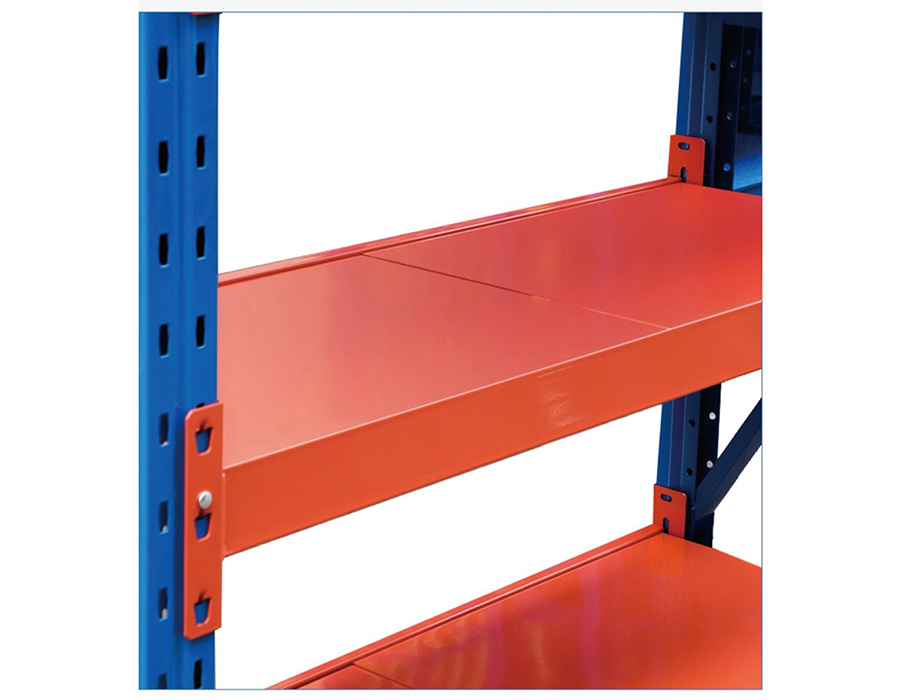
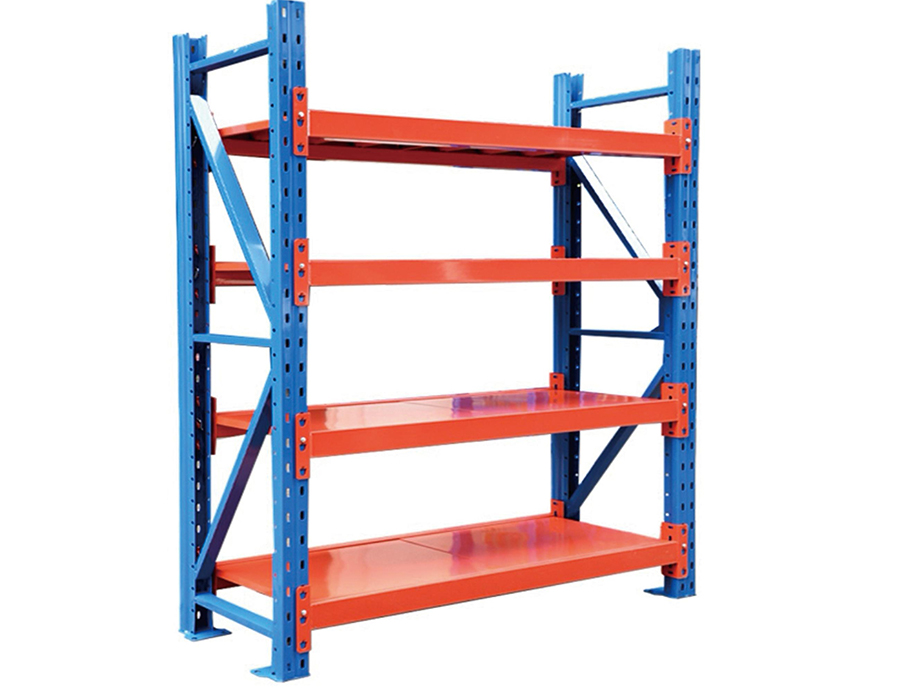
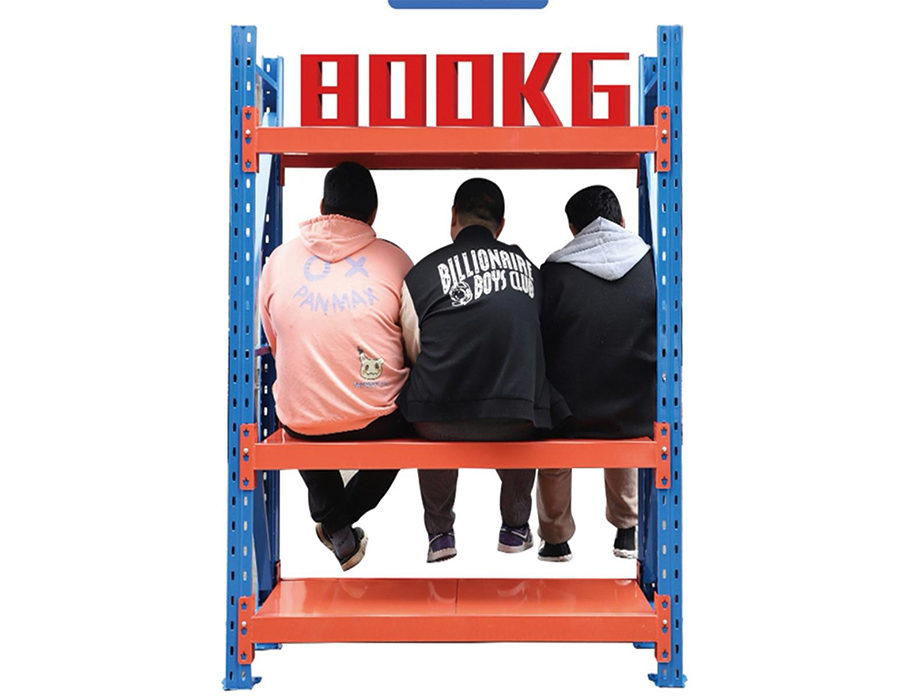
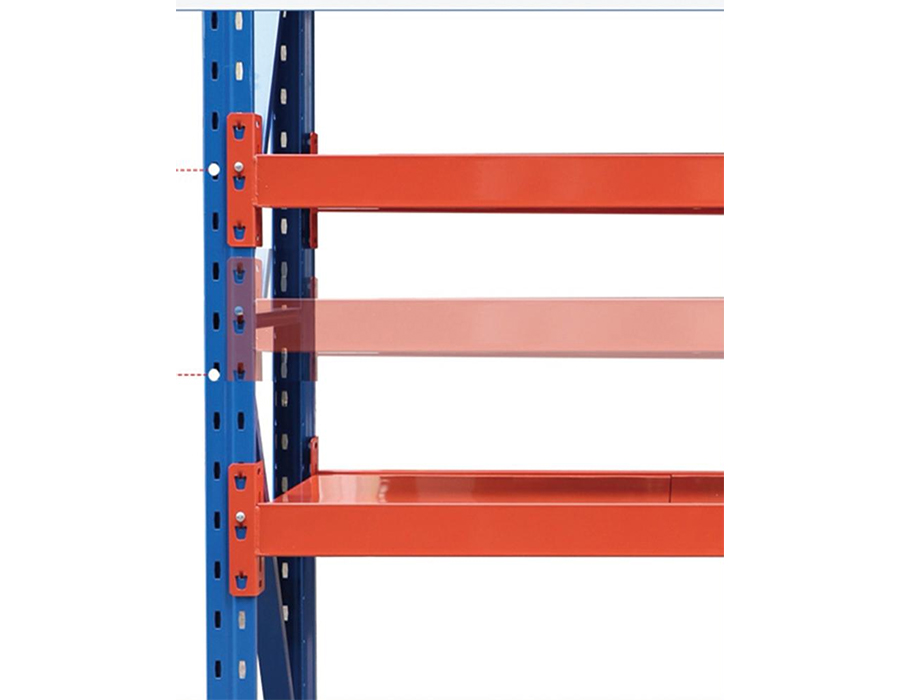
Medium-duty boltless shelving reinforces the upright profile and shelf plate thickness relative to its light-duty counterpart, delivering a significantly higher per-shelf load capacity while retaining the tool-free, bolt-free assembly convenience of the boltless design.
Shelf heights remain fully adjustable, making the system suitable for medium-sized boxed goods, tools and accessories, and semi-finished materials — balancing storage volume with ease of daily operation.
Integrated diagonal braces strengthen the structure against deformation under load, while horizontal cross-braces enhance stability and facilitate safe manual repositioning; multiple dimensions are available for customisation to suit specific warehouse layouts.
Widely used in manufacturing shop-floor kitting areas, automotive parts depots, building materials back-stores, and industrial B2B e-commerce warehouses — the most cost-effective medium-load storage solution available.

Picture a warehouse at the end of a shift: pallets of finished goods waiting in the receiving bay, ...
Read MoreWhen a forklift drops a full pallet onto a rack beam, the structure receives more than static weigh...
Read MoreAnhui Huijian Intelligent Equipment Co., Ltd. recently welcomed a delegation of representatives from...
Read MoreWhy Mould Racks Are a Core Workflow Tool In any production environment that relies on molds—injecti...
Read MoreWhat Is Light-Duty Boltless Shelving? Light-Duty Boltless Shelving is a type of storage rack designe...
Read MoreMedium-duty boltless shelving occupies a structurally demanding middle ground — it must handle per-shelf loads typically ranging from 200 kg to 500 kg while remaining cost-effective and reconfigurable. The two variables that determine whether a unit actually delivers on those ratings are the base steel gauge and the cold-rolled profile geometry of the beam. These two factors interact: a thicker gauge in a shallow C-profile will underperform a slightly thinner gauge formed into a closed-box or hat-section profile, because the moment of inertia of the cross-section — not raw material weight — governs bending resistance.
In practice, medium-duty beams are most commonly produced in 1.5 mm, 1.8 mm, or 2.0 mm cold-rolled steel. The jump from 1.5 mm to 2.0 mm increases beam weight by roughly 33%, but when combined with an optimized hat-section profile, load capacity can improve by 50–70% at equivalent spans. This is why two shelving units priced similarly but specced differently can perform very differently in the field. At Huijian, our medium-duty beam profiles are engineered through our in-house R&D center to balance material efficiency with structural output — a distinction that becomes evident when you compare deflection curves rather than just rated load numbers.
The slotted or perforated upright column is the defining element of boltless shelving, yet the perforation pattern itself is rarely scrutinized during procurement. Column perforations serve two functions simultaneously: they provide the connection points for beam connectors, and they reduce the net cross-sectional area of the column, which directly affects compressive load capacity. These two objectives are in tension — more perforation slots mean more flexibility but less column strength.
Medium-duty uprights must manage this trade-off carefully. A column with 50 mm pitch slotting across its full height will have a significantly lower net section modulus than one with 50 mm pitch only in the mid-zone and solid steel at top and bottom where compressive stress concentrations peak. High-quality medium-duty columns also feature embossed ribs or longitudinal stiffening folds in the column wall between perforation rows, which restore torsional rigidity that the slots remove. When evaluating upright columns, look for these stiffening features rather than relying solely on the stated gauge thickness.
Column cross-section shape matters as well. Square-tube uprights offer balanced resistance in both horizontal axes — useful in double-row configurations where lateral loads arrive from two directions. Open-back or C-channel uprights save material cost but must be braced or back-connected more aggressively to prevent twisting under eccentric loads. For medium-duty applications with shelf loads above 300 kg per level, square-tube uprights are generally the safer specification.
Medium-duty shelving products are marketed with load ratings that are not always defined consistently across suppliers. Understanding what each rating type measures is essential for accurate specification.
| Rating Type | What It Measures | Test Condition | Practical Relevance |
| Static Load (per shelf) | Maximum evenly distributed weight a shelf can hold at rest | Load applied gradually, no impact | Baseline comparison; does not reflect real warehouse use |
| Dynamic Load (per shelf) | Maximum load accounting for repeated loading/unloading cycles | Cyclic application, typically 1.25× static factor | Relevant for pick-and-pack or high-turnover environments |
| UDL (Uniformly Distributed Load) | Load assumed to be perfectly spread across the full shelf area | Theoretical; rarely achieved with real goods | Must be derated for concentrated loads or point contacts |
| Point Load Capacity | Maximum load concentrated at a single contact point | Load applied via small-area pad at worst-case location | Critical for machinery parts, engines, or crated goods |
| Column Load (per upright) | Total cumulative load an upright can carry across all shelf levels | Full system loading test | Governs maximum total bay load; often the binding constraint |
In real warehouse scenarios, the UDL assumption is almost never met. Cartons stacked on a shelf rest on their base footprints — often covering less than 60% of the shelf surface — which creates a concentrated load profile significantly worse than the UDL model predicts. A reliable rule of thumb is to apply a 0.7× derating factor to the stated UDL capacity when the goods being stored have base footprints smaller than half the shelf area.
As medium-duty shelving runs increase in height — particularly above 2.0 m — the bracing configuration transitions from a convenience feature to a structural necessity. Most boltless shelving systems rely on diagonal or horizontal back bracing panels to prevent racking, which is the tendency of the frame to parallelogram under horizontal forces such as lateral shelf loading, accidental impacts, or seismic activity.
Back panels — typically wire mesh or perforated steel sheets that span the full rear face of a bay — provide continuous bracing and double as a backstop to prevent items from being pushed off the rear of the shelf. They add significant racking resistance because they act as a shear diaphragm across the entire bay height. The trade-off is that they block rear access and add weight, which matters in double-sided pick configurations. Cross-brace systems use a pair of diagonal steel straps forming an X-pattern at the rear. They are lighter, allow rear access, and are easier to install, but their bracing effectiveness depends critically on correct tensioning — a slack cross-brace provides almost no racking resistance and is a common installation defect in the field.
In shelving runs exceeding six bays, intermediate bracing frames should be inserted at every fourth or fifth bay to prevent progressive racking propagation. Without intermediate frames, a lateral force applied at one end of a long run can transmit through beam-to-upright connections and cause accumulated displacement at the far end — even if each individual bay appears stable in isolation. This is a detail that our technical team at Huijian addresses explicitly in layout recommendations for clients specifying long runs in high-bay medium-duty configurations.
Warehouse operators frequently face the decision of whether to add new shelving bays to an existing installation from a different supplier, or to integrate components purchased in different years when a manufacturer has updated its product line. Both scenarios carry compatibility risks that are underappreciated until installation day.
The safest approach when expanding an existing installation is to source from the original manufacturer and specify the same product generation. Where that is not possible, a mechanical trial fit of representative components before bulk ordering is a minimal but essential verification step.
Industrial Medium-Duty Boltless Shelving is often used in hybrid environments where standard pallets or half-pallets are stored alongside loose cartons. In these cases, the nominal bay dimensions must be matched carefully to pallet footprint standards to avoid wasted space or unsafe overhangs.
Standard Euro pallets (1200×800 mm) and GMA pallets (1219×1016 mm) have different footprints, and a bay dimensioned for one will not optimally accommodate the other. For Euro pallet storage on medium-duty shelving, a beam span of 1300 mm and a shelf depth of 850 mm provides a 50 mm clearance buffer on each side — sufficient to avoid beam contact under normal placement but not so generous as to allow significant lateral pallet movement. For GMA pallets, a 1400 mm span and 1100 mm depth are more appropriate minimums.
Shelf depth also governs whether a second pallet row can be stored front-to-back without a dedicated deep-storage configuration. Double-depth pallet storage on medium-duty shelving requires depths of 1700 mm or more, which typically necessitates a center support beam to prevent mid-span deflection on the lower shelf level where combined pallet loads can exceed 600 kg. This center beam adds cost but is non-negotiable for structural integrity at those loads and spans.
In regions with moderate seismic activity — a category that includes significant portions of eastern and southern China — medium-duty shelving systems require evaluation beyond standard static load ratings. Seismic forces act horizontally on shelf contents, and the inertial loads generated by heavy goods on upper shelves can exceed the lateral resistance of standard boltless connector systems during a ground acceleration event.
The key parameters to evaluate are the system's base shear resistance, which is the total horizontal force the shelving can resist before the frame displaces, and the connector pullout strength under combined vertical and lateral loading. Standard medium-duty beam connectors are tested under purely vertical loading conditions. Under combined loading — which is what seismic or impact scenarios produce — effective engagement depth decreases and the connector is subjected to rotational stress at the hook point. Systems with secondary locking pins or welded clip reinforcements perform significantly better under these conditions.
We incorporate seismic performance considerations into our medium-duty product specifications, and clients in higher-risk zones are encouraged to consult with our engineering team early in the project planning phase to ensure appropriate configuration recommendations are built into the layout from the start.
Our Professional Team
Is Ready to Support You.


 Medium-Duty Boltless Shelving Manufacturers




 English
 Español