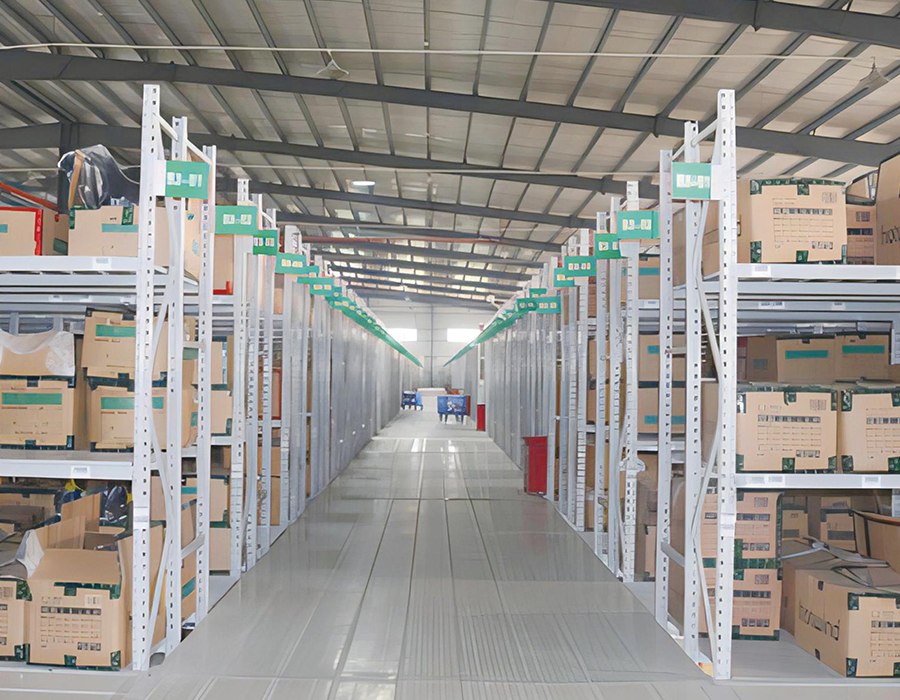
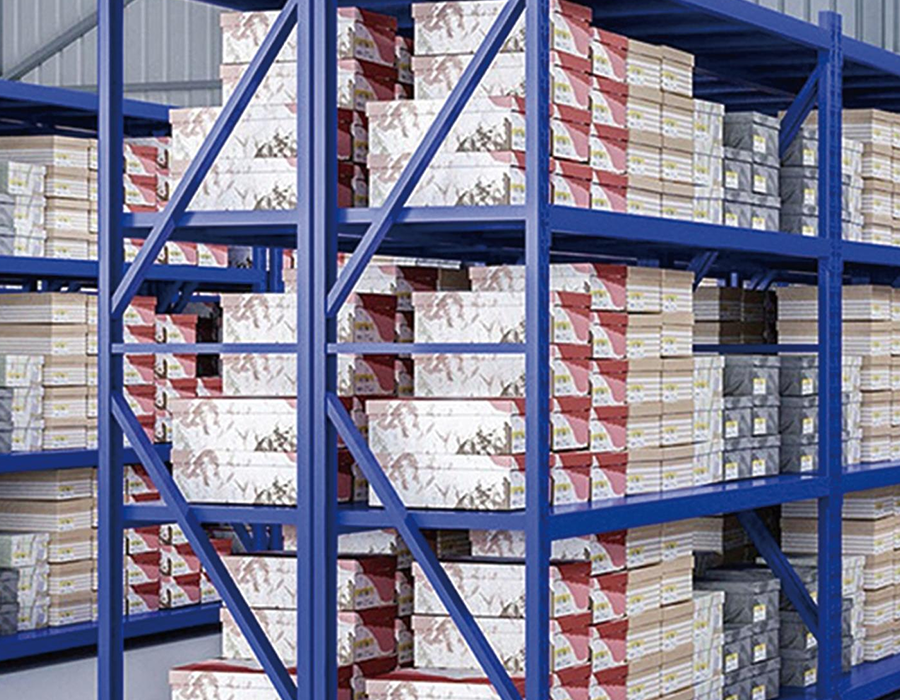
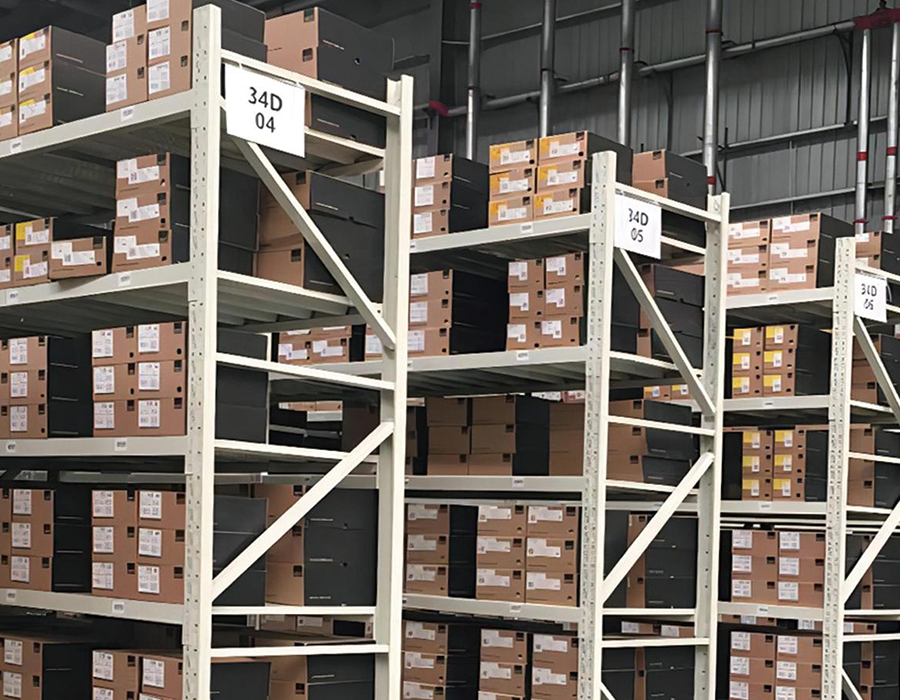
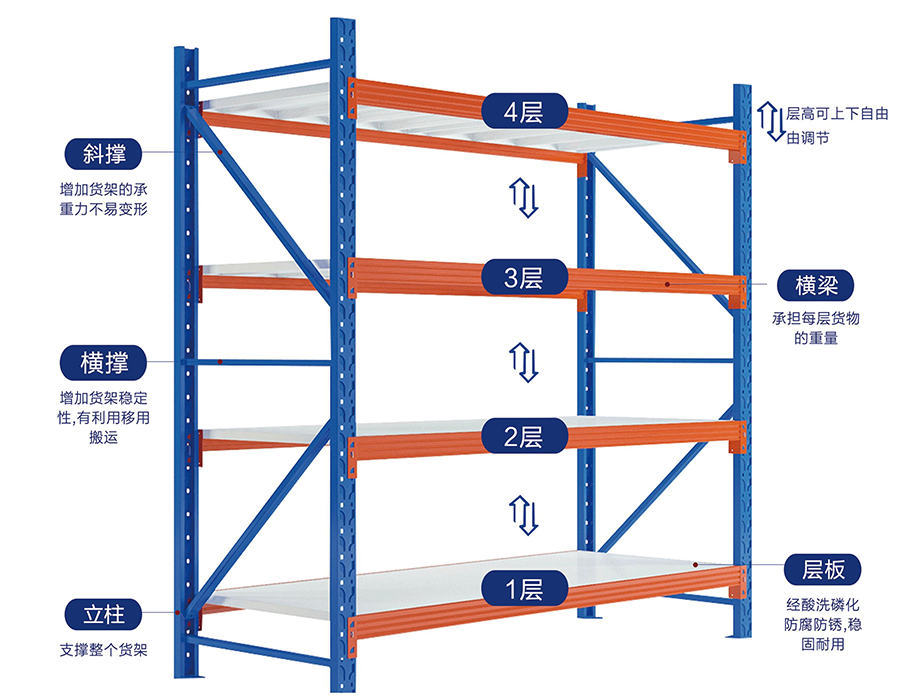
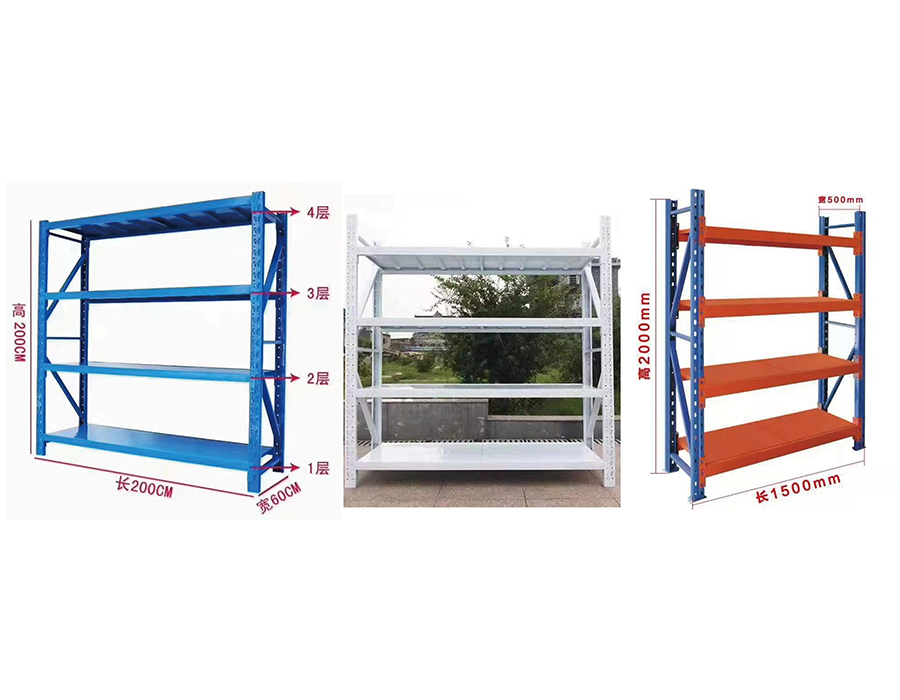
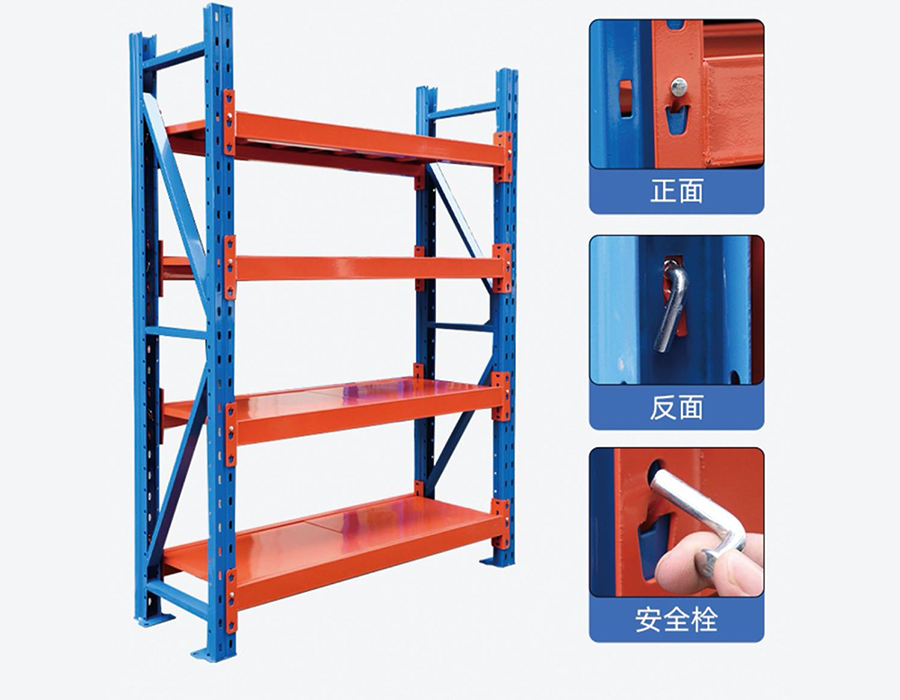
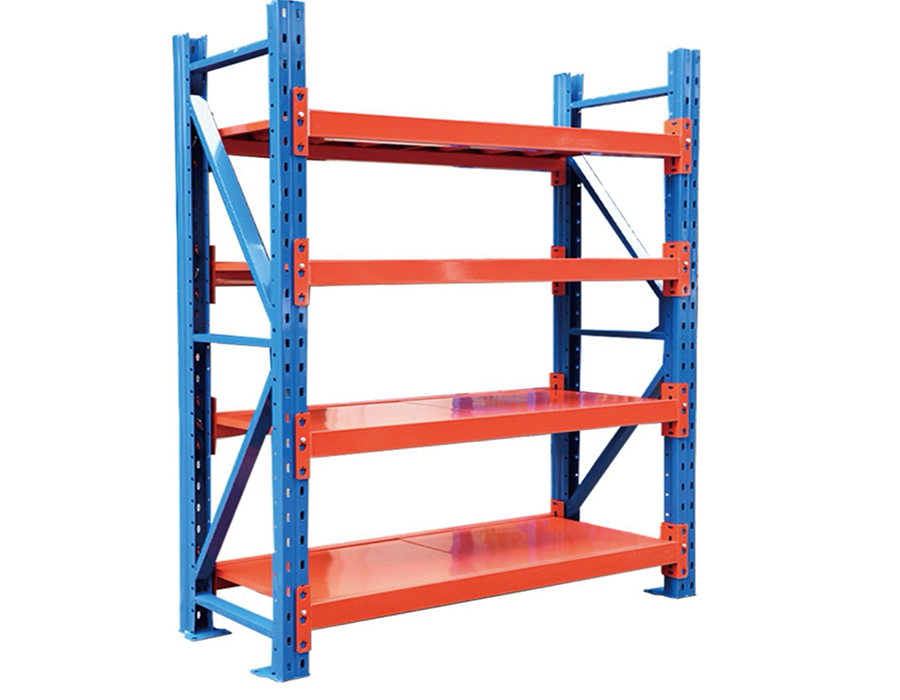
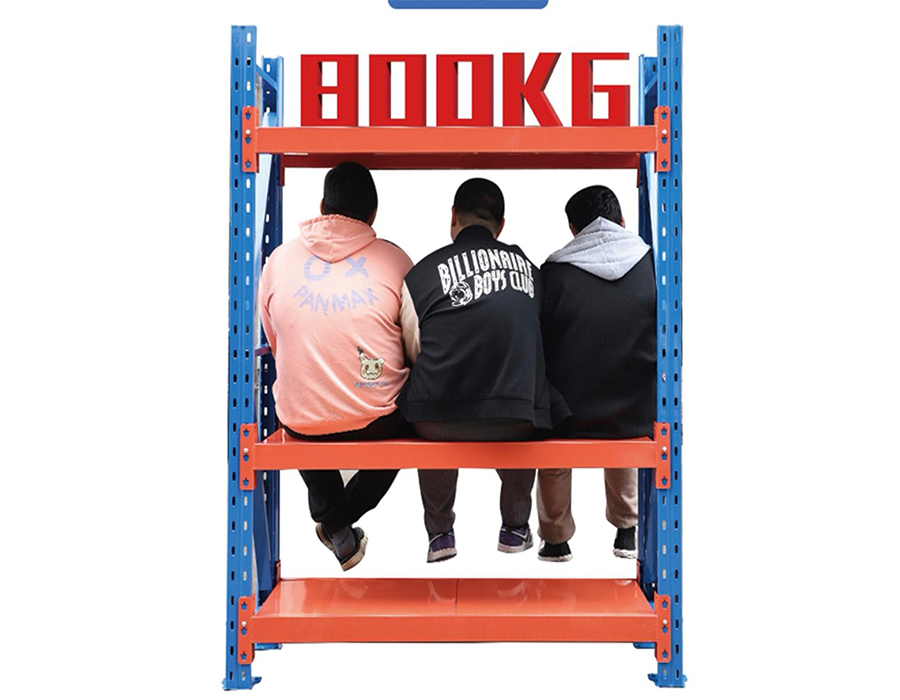
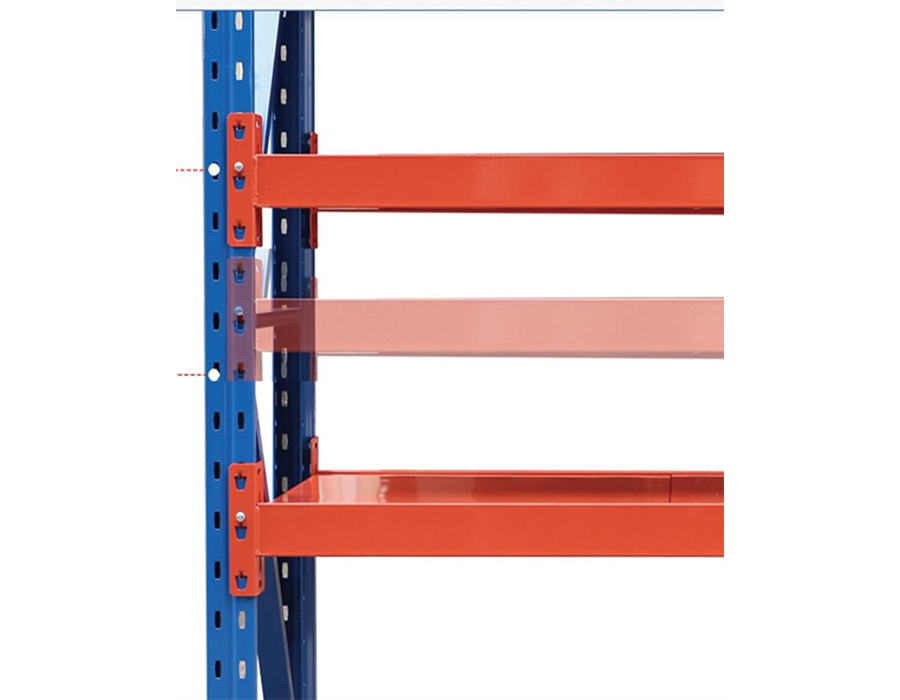
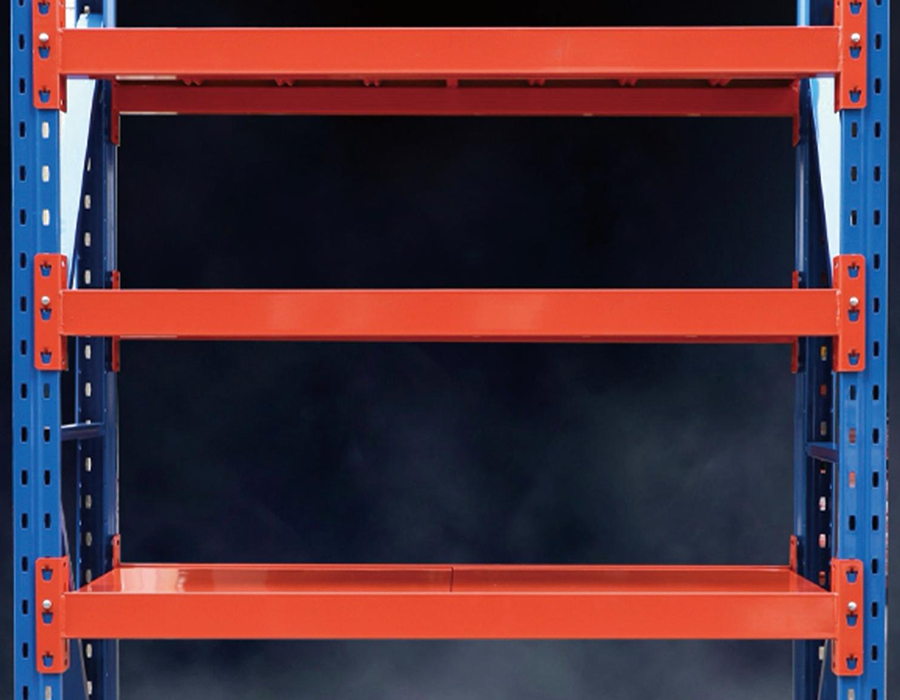
Light-duty boltless shelving assembles without a single fastener, with adjustable shelf heights that can be reconfigured quickly to accommodate changing product dimensions — a key advantage in environments where layout flexibility is regularly required.
Designed primarily for manual access, the lightweight structure suits the storage of small loose parts, documentation, and light packaged goods, making it a standard choice for office storage, retail back-rooms, and small-format picking areas.
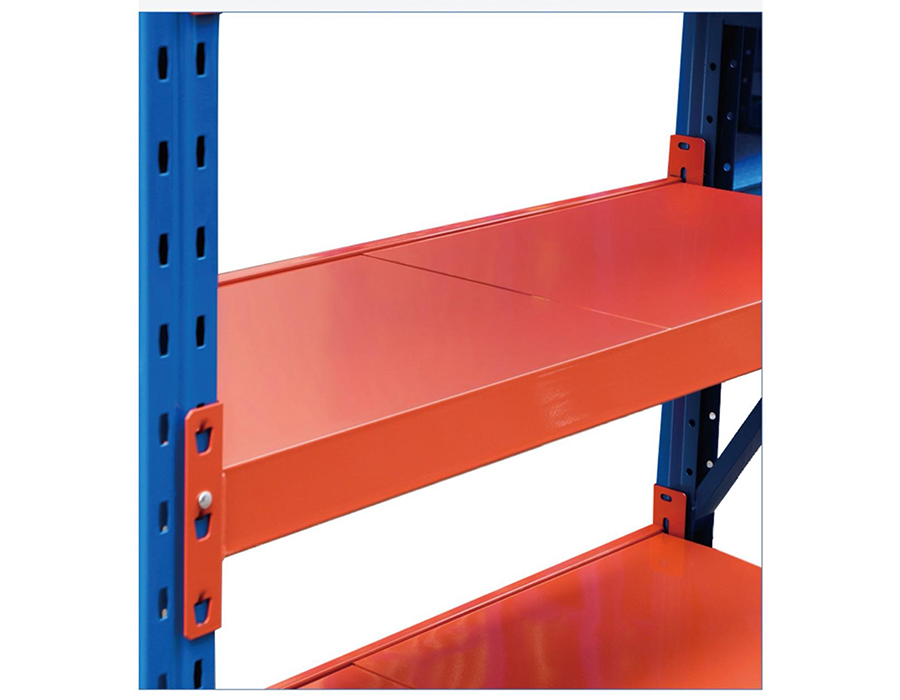
Uprights are treated with phosphate acid-wash for corrosion resistance, and shelves are manufactured from cold-rolled steel with a powder-coated finish, ensuring a durable and visually clean installation throughout their service life.
Typical applications include office environments, retail back-of-store rooms, light industrial workshops, and small e-commerce warehouses where moderate capacity requirements are combined with a high need for organisational flexibility.
Picture a warehouse at the end of a shift: pallets of finished goods waiting in the receiving bay, ...
Read MoreWhen a forklift drops a full pallet onto a rack beam, the structure receives more than static weigh...
Read MoreAnhui Huijian Intelligent Equipment Co., Ltd. recently welcomed a delegation of representatives from...
Read MoreWhy Mould Racks Are a Core Workflow Tool In any production environment that relies on molds—injecti...
Read MoreWhat Is Light-Duty Boltless Shelving? Light-Duty Boltless Shelving is a type of storage rack designe...
Read MoreOne of the most frequently misunderstood aspects of light-duty boltless shelving is the relationship between beam span and actual load-bearing capacity. The rated load per shelf is typically calculated at the midpoint of a fully supported beam — meaning that as the span between uprights increases, the effective load capacity drops non-linearly. For a shelf rated at 150 kg with a 900 mm span, extending that span to 1200 mm without adjusting the beam gauge can reduce real-world capacity to under 100 kg under dynamic warehouse conditions. This is why span selection should always precede load planning, not follow it.
In our production process at Huijian, beam profiles are cold-rolled to specific gauge tolerances precisely because minor deviations in steel thickness compound significantly over longer spans. A 0.2 mm under-tolerance in a 1.5 mm beam can produce visible deflection at loads well below the rated threshold. When specifying shelving for pick-and-pack environments where staff repeatedly load and unload shelves, dynamic load factors — typically 1.25× the static value — should always be applied.
Light-duty boltless shelving systems use one of two primary connector types: the rivet-style (punched tab) and the clip or hook-in style. These are not interchangeable design preferences — they reflect different structural philosophies and have real consequences for installation, reconfiguration, and seismic or vibration resistance.
When evaluating systems, check the connector engagement depth and the presence of a secondary retention mechanism before making a purchase decision based on price alone.
Most boltless shelving products advertise "25 mm pitch adjustability," but this number only tells part of the story. The usable adjustment range is constrained by the distance between the top of the beam itself and the underside of the shelf above — which means in practice, pitch granularity matters most in the middle zones of a run, not at the top or bottom where fixed structural constraints dominate.
A practical issue that arises in mixed-SKU warehouses is the "half-pitch trap": when a picker needs to store items of 210 mm height but the available pitches jump from 200 mm to 225 mm, the extra 25 mm of dead space per shelf accumulates across a 5-tier, 20-bay system into a significant loss of usable vertical storage. Facilities that conduct a proper SKU height audit before shelving installation routinely achieve 15–25% better vertical utilization than those that use default configurations.
We design our upright columns with a consistent 50 mm pitch at standard configurations, and clients working with our technical team on project customization can request 25 mm pitch columns for mixed-height inventory environments — a detail that pays for itself quickly in dense storage scenarios.
Boltless shelving is available with several surface treatments, and the choice has direct implications for service life, load capacity (due to coating thickness), and environmental suitability.
| Treatment Type | Typical Coating Thickness | Salt Spray Resistance | Best Environment | Notes |
| Powder Coat (Epoxy) | 60–80 µm | 500–800 hrs | Indoor dry warehouses | Wide color range; chips under impact |
| Electrogalvanized | 5–12 µm | 96–200 hrs | Indoor light-humidity | Lower corrosion protection; cost-effective |
| Hot-Dip Galvanized | 45–85 µm | 1000+ hrs | Cold storage, coastal, outdoor | Adds weight; dimensional tolerances looser |
| Powder Coat (Polyester) | 60–100 µm | 600–1000 hrs | UV-exposed or humid indoor | Better UV stability than epoxy powder coat |
A common mistake is specifying electrogalvanized shelving for facilities with floor-wash-down routines or proximity to loading dock doors. The thin zinc layer saturates quickly in repeated moisture exposure, and visible rust appears within 12–18 months — often voiding warranty claims if the humidity specifications weren't followed. Huijian's standard production lines apply epoxy powder coat at 60–80 µm as a baseline, with hot-dip galvanized options available for clients in food processing, cold chain, or coastal logistics environments.
Industrial light-duty boltless shelving is frequently deployed as freestanding runs without floor anchoring — which is compliant in many low-risk environments but becomes a liability in others. The decision matrix is more nuanced than simply checking whether seismic zoning requires anchors.
Shelving runs exceeding 2.4 m in height, or those with a height-to-depth ratio above 6:1, are inherently prone to tipping under eccentric loading — a scenario that occurs whenever pickers consistently load one side of a bay before the other. The physics here are straightforward: a 2.4 m tall unit with 400 mm depth has a tipping moment that can be exceeded by a single 30 kg load placed at the top shelf edge on one side.
Wall ties are a common alternative to floor anchoring when the floor surface is unsuitable for drilling (e.g., raised access floors, membrane-coated surfaces). However, wall ties are only effective if the wall itself is structurally adequate. A single-skin drywall partition is not a valid anchor point for a loaded run of shelving. Engineers specifying wall ties should verify the wall construction and use appropriate cavity anchors or through-bolts where stud spacing allows.
Many boltless shelving uprights include adjustable leveling feet as a standard feature. Beyond leveling uneven floors, these feet play a critical load-transfer role: they distribute the upright's point load over a larger contact area, preventing stress concentration on soft or coated floor surfaces. For shelving on epoxy-coated warehouse floors, specifying feet with a minimum base plate area of 50 cm² is a practical guideline to avoid coating damage under heavy loads.
A well-specified boltless shelving system is rarely just uprights and flat decks. The accessory ecosystem significantly expands functional utility and should be evaluated during the initial specification phase rather than retrofitted later — as upright slot compatibility varies between manufacturers and mixing brands often creates fitment issues.
At Huijian, we provide full accessory compatibility documentation across our shelving product lines, so clients can plan integrated configurations from the start rather than discovering fitment limitations during installation.
Deflection — the vertical bow of a loaded shelf beam or deck panel — is one of the most telling indicators of shelving quality, yet it is rarely prominently disclosed in product specifications. The industry reference standard for acceptable deflection in warehouse shelving is L/180, where L is the span in millimeters. For a 900 mm span, this permits a maximum midpoint deflection of 5 mm under full rated load. For a 1200 mm span, the same ratio allows 6.67 mm.
Why does this matter practically? Excessive deflection creates several cascading problems: shelf decks that bow force items toward the center, creating unstable stacking conditions; in multi-tier systems, deflection under the upper shelf can compress vertical clearance below its nominal value; and repeated loading-unloading cycles on a shelf that regularly reaches its deflection limit accelerate metal fatigue at the beam-to-upright connection points. When evaluating shelving quotes, asking suppliers for their tested deflection value at 100% rated load — not just the rated load itself — reveals far more about actual quality than price comparisons alone.
Our Professional Team
Is Ready to Support You.


 Light-Duty Boltless Shelving Manufacturer




 English
 Español