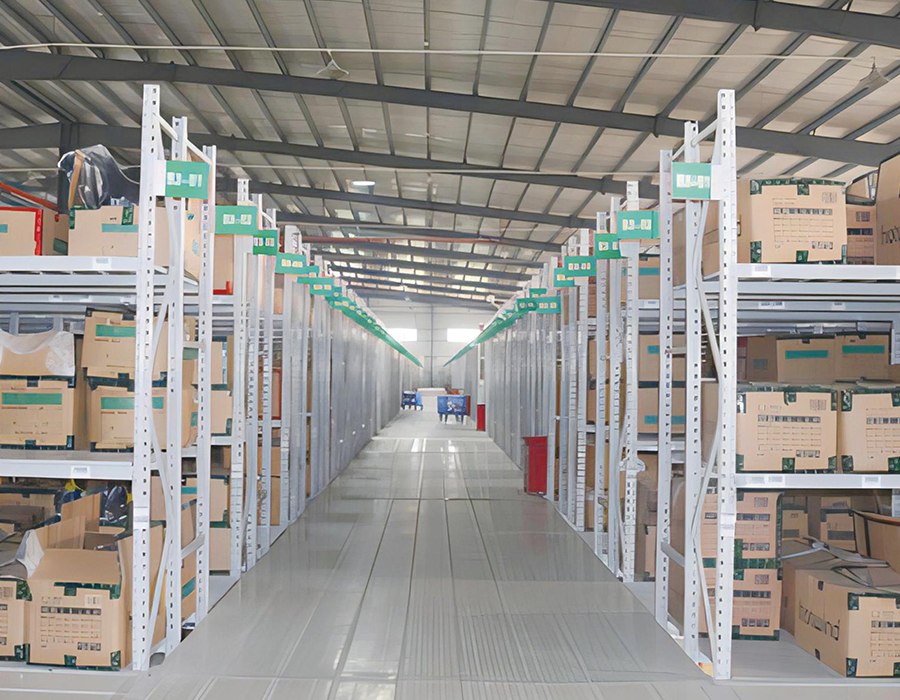
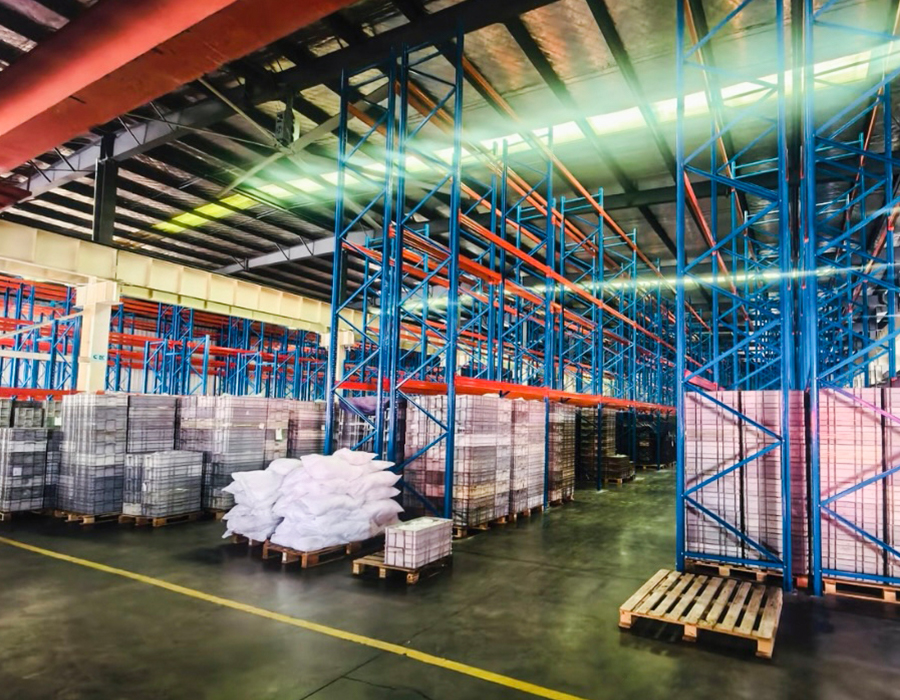
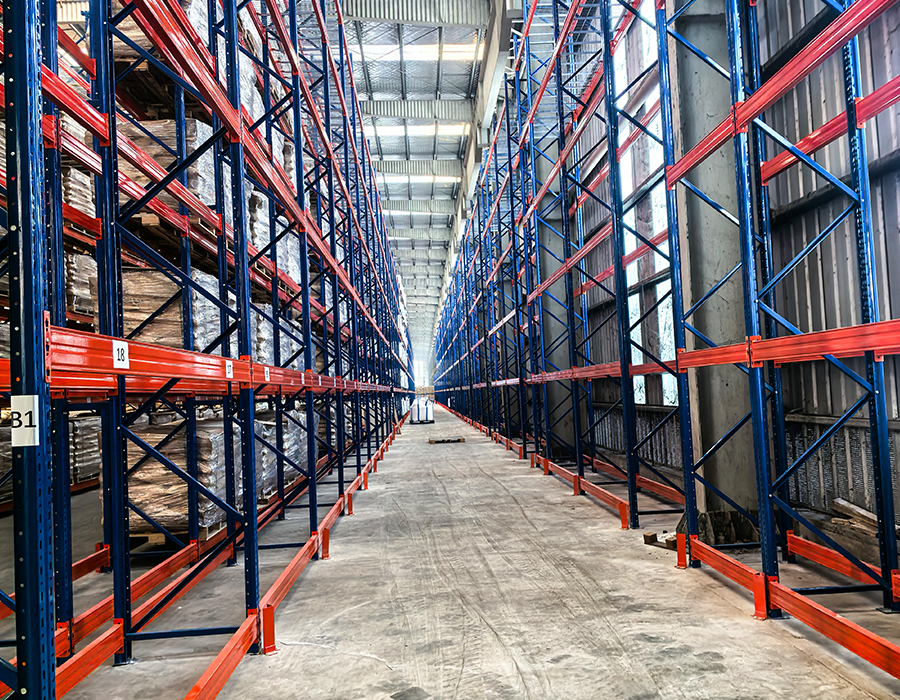
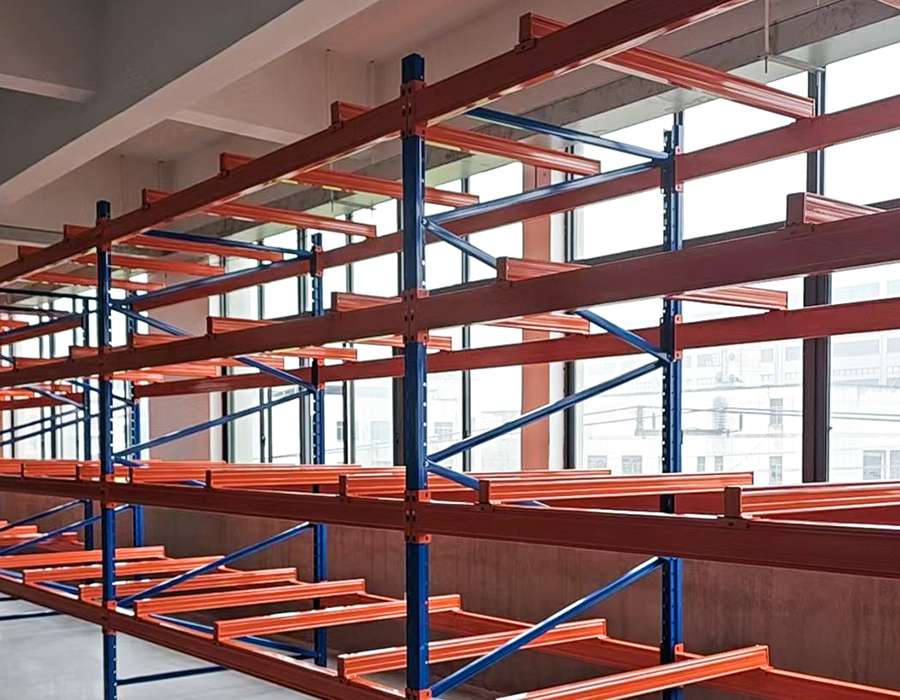
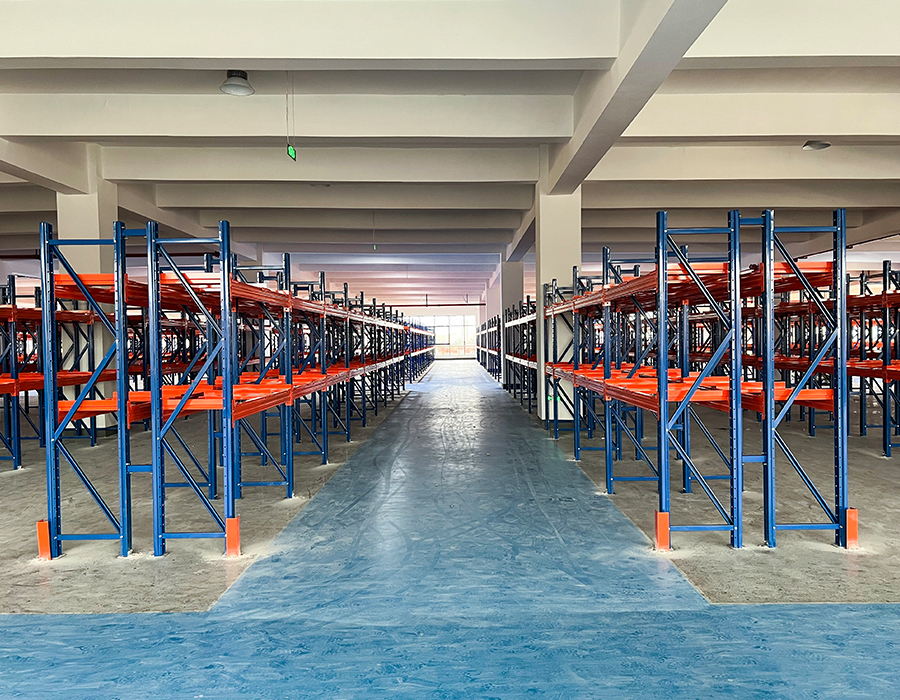
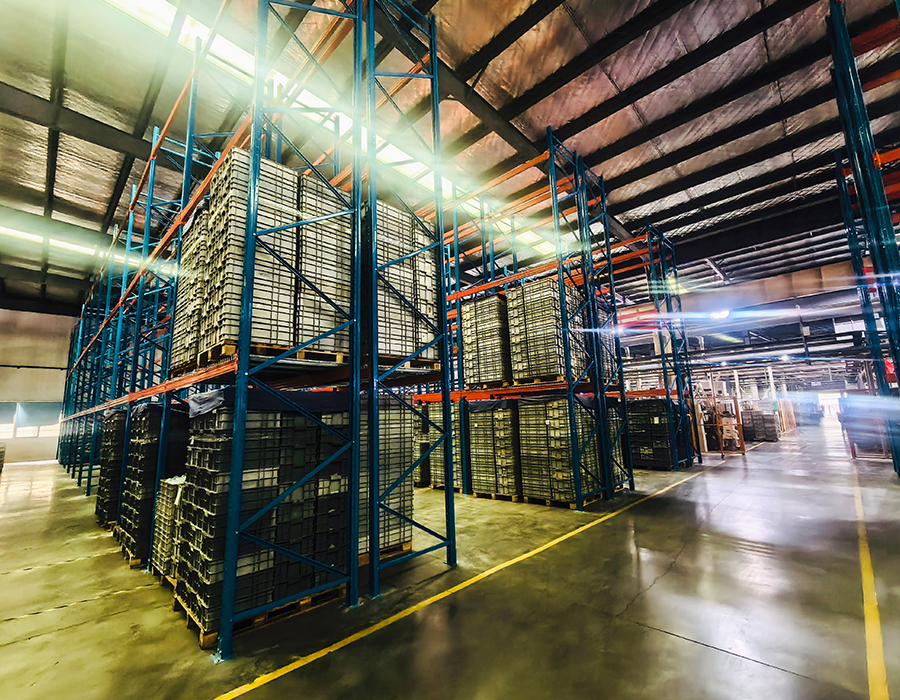
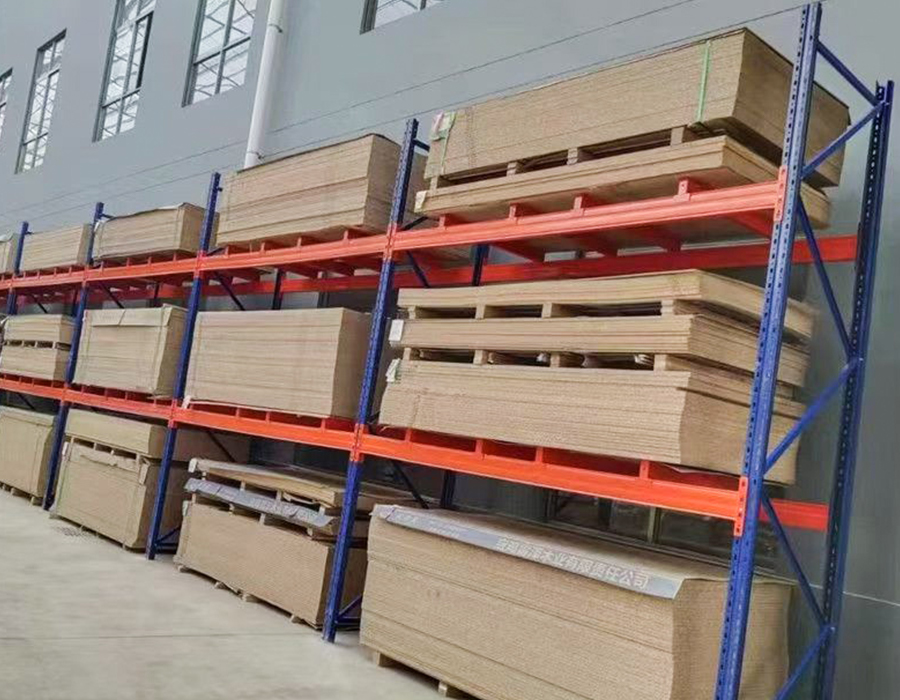
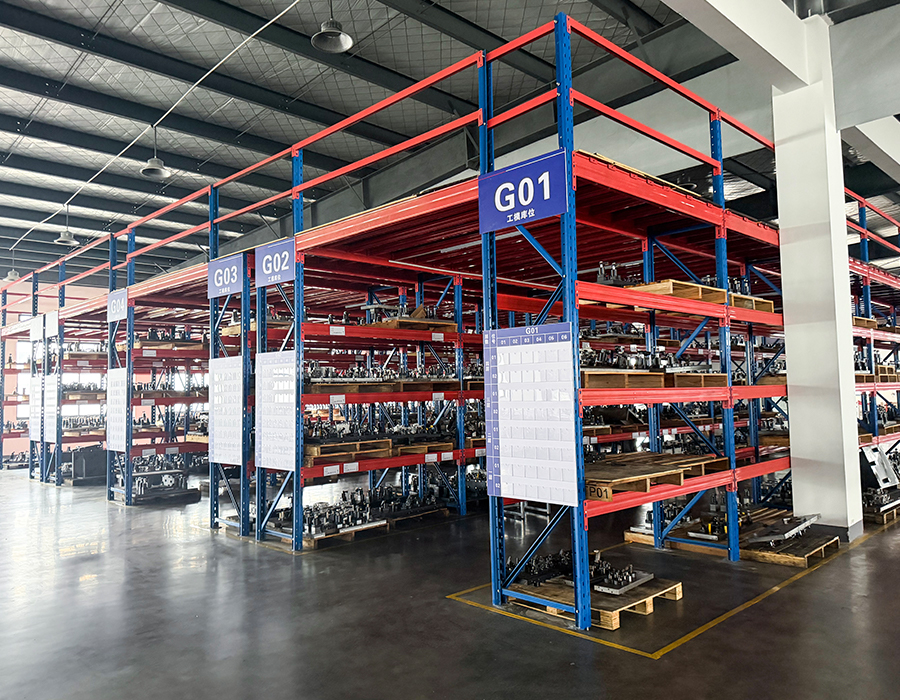
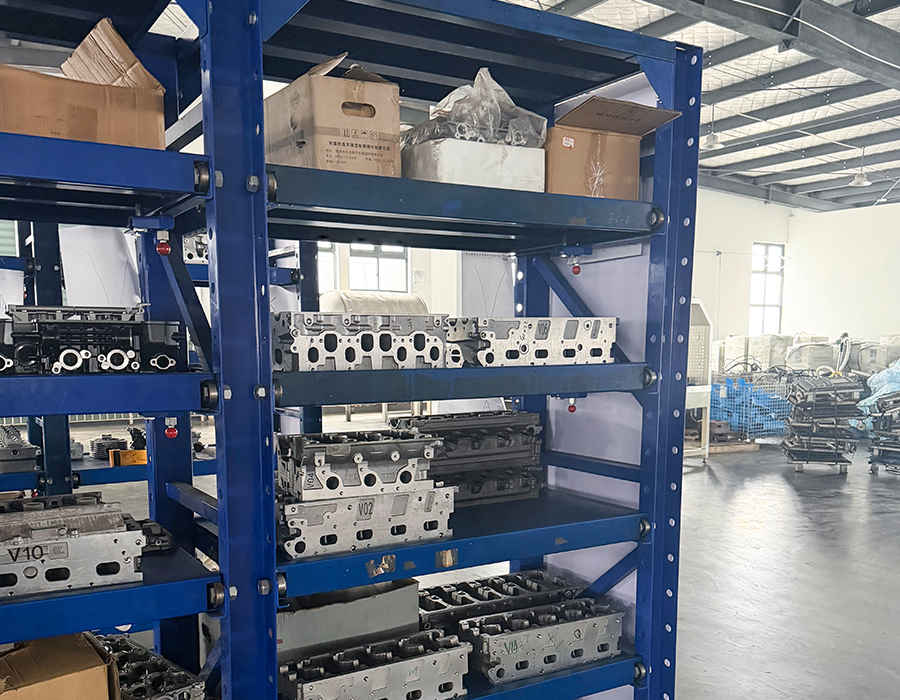
Heavy-duty boltless shelving is engineered for high-load applications, supporting up to 800 kg per shelf level, with thickened uprights and reinforced shelf plates secured by safety locking pins that prevent lateral displacement under maximum rated loads.
The diamond-hole column pattern allows each shelf board to be repositioned within a four-hole range without any tools, providing quick height adjustment in response to changing product dimensions — a significant operational advantage in dynamic storage environments.
Assembly requires no screws: shelf boards lock directly into the column holes via safety pins on both faces of the upright, forming a robust connection that resists accidental dislodgement from forklift or handling impacts.
Widely deployed in industrial warehouses, automotive parts distribution, mechanical components storage, and building materials facilities — the recommended choice wherever high per-shelf load capacity must coexist with flexible, tool-free reconfiguration.

Picture a warehouse at the end of a shift: pallets of finished goods waiting in the receiving bay, ...
Read MoreWhen a forklift drops a full pallet onto a rack beam, the structure receives more than static weigh...
Read MoreAnhui Huijian Intelligent Equipment Co., Ltd. recently welcomed a delegation of representatives from...
Read MoreWhy Mould Racks Are a Core Workflow Tool In any production environment that relies on molds—injecti...
Read MoreWhat Is Light-Duty Boltless Shelving? Light-Duty Boltless Shelving is a type of storage rack designe...
Read MoreThe name "boltless shelving" draws attention to what is absent — fasteners — but the engineering substance of a heavy-duty boltless shelving system lies entirely in what replaces them: the rivet connector, also called a clip, tab, or teardrop connection depending on the design family. This connector is a cold-formed steel tab on the beam end that engages a punched slot pattern in the upright column, locking under load without mechanical fasteners. The geometry of this engagement — tab shape, slot dimensions, tab insertion angle, and the depth of the locking shoulder behind the slot — determines not only the static load capacity but the fatigue resistance, disassembly ease, and long-term connection reliability of the entire system.
The most widely used connector family uses a teardrop slot in the column paired with a formed hook tab on the beam. When the beam is lifted slightly after insertion, a locking shoulder on the tab drops behind the slot edge, preventing withdrawal under vertical load. What distinguishes high-quality connectors from marginal ones in this design is the dimensional precision of the hook-to-shoulder engagement: a shoulder depth of 3–4mm provides reliable locking with meaningful pull-out resistance; a shoulder depth of 1–2mm, achievable through less precise forming, allows the connection to release under vibration or upward shock loading — a failure mode that is visually identical to a correctly assembled connection until the beam drops. Buyers cannot assess this dimension without disassembly and measurement, which is why material certificates and dimensional inspection reports from the manufacturer carry more weight than visual inspection of finished assemblies.
The second critical parameter is the number of connector tabs per beam end. Single-tab connections are adequate for light-duty shelving but introduce a rotational degree of freedom — the beam can twist about the single engagement point under eccentric loading. Heavy-duty boltless shelving under industrial loads requires a minimum of two tabs per beam end, spaced vertically to eliminate beam rotation and distribute the shear load across two engagement points. Some heavy-duty designs use three or four tabs per end, which further reduces connector stress per tab and increases resistance to dynamic loading from items being placed forcefully or from vibration-transmitting equipment nearby.
The punched slot or hole pattern in boltless shelving upright columns is designed primarily to allow shelf height adjustment in fixed increments — typically 25mm, 38mm, or 50mm pitch depending on the system. This functional purpose is understood by most users. What is less widely recognized is that the perforation pattern has a direct and significant effect on the net cross-sectional area of the upright and therefore on its compressive load capacity and local buckling resistance — parameters that determine the maximum safe upright load and the practical height limit of the shelving system.
Each punched slot removes steel from the upright cross-section at that location. In a heavily perforated column — where slots are closely spaced at 25mm pitch with minimal web material between consecutive slots — the net section at any slot group can be reduced by 25–40% compared to the gross section of the column profile. This reduction directly lowers the column's moment of inertia and radius of gyration at that cross-section, making it the critical location for local buckling initiation under axial compression. Manufacturers who design industrial heavy-duty boltless shelving for genuinely high upright loads account for this net section reduction in their column capacity calculations; those who apply gross section properties throughout produce capacity tables that are unconservative by a significant margin for heavily perforated profiles.
The practical consequence for buyers is that column capacity tables from different manufacturers are not directly comparable unless the perforation pattern and net section reduction are known for each. A 2.0mm thick column with 25mm slot pitch may have a lower effective upright capacity than a 1.8mm thick column with 50mm pitch and a more favorable net section, despite the thicker material. When evaluating industrial heavy-duty boltless shelving for applications approaching the rated upright capacity, requesting the net section coefficient — the ratio of net to gross cross-sectional area at the governing slot group — provides a meaningful basis for comparison that nominal column thickness alone does not.
Shelf panel deflection under load is the most visible structural behavior in heavy-duty boltless shelving and the parameter most directly noticed by users — a visibly sagging shelf signals overloading or inadequate panel design even to non-technical observers. However, managing deflection to within acceptable limits requires different design approaches depending on the shelf span, the load magnitude, and whether the governing concern is structural adequacy or serviceability appearance, and each approach involves specific trade-offs in material weight, cost, and load capacity.
The simplest deflection reduction method is increasing the steel plate thickness of the shelf panel. Deflection under a uniformly distributed load varies inversely with the cube of the panel thickness for flat plate bending — doubling thickness from 1.0mm to 2.0mm reduces deflection to one-eighth, a dramatic improvement. However, flat plate panels above 2.0mm become very heavy relative to their load capacity increase, and the weight of the panel itself begins to consume a meaningful portion of the rated shelf capacity. For spans above 1,500mm under heavy-duty loads, flat plate alone is rarely the most efficient solution.
Introducing longitudinal ribs or corrugations into the shelf panel cross-section — formed during roll-forming or press-braking — converts the flat plate into an effective structural section with a significantly higher moment of inertia than the base material thickness alone would suggest. A 1.5mm corrugated panel can outperform a 2.5mm flat panel in mid-span deflection for the same span and load, at approximately 40% lower panel weight. The functional limitation is that ribbed or corrugated surfaces are not uniformly flat — objects with small base areas may rest on rib peaks only, creating localized contact stresses, and liquids or fine particulates collect in the flutes.
For the highest-capacity industrial heavy-duty boltless shelving configurations, the shelf is designed as a composite assembly: structural beams spanning between uprights support a separate inset deck panel that spans only between adjacent beams, not across the full shelf width. This approach allows beam depth — and therefore bending resistance — to be optimized independently of the deck panel thickness, achieving large load capacities with controlled deflection without the weight penalty of a monolithic plate spanning the full width. The trade-off is assembly complexity and the need for a deeper shelf profile that may reduce the number of shelf levels achievable within a fixed bay height.
Industrial heavy-duty boltless shelving installed at heights of 2.5m to 4m or above — which is common in high-bay parts storage, automotive component warehouses, and archival storage facilities — frequently requires column splicing, where two or more column lengths are joined vertically to achieve the required height. The splice connection is a critical structural detail that is often treated as a simple mechanical joint but actually governs the buckling behavior of the full-height column in ways that are not always reflected in the load tables published for standard-height configurations.
The primary structural requirement of a column splice is that it must transfer axial compression load across the joint without introducing a local weak point that triggers buckling at the splice location before the column as a whole reaches its rated capacity. A splice achieved by simply inserting a shorter column section over the lower column and relying on friction or a single fastener through overlapping column walls provides minimal bending resistance at the joint — it behaves structurally as a pin connection rather than a moment-continuous column, effectively halving the buckling length at which the column should be analyzed. This distinction matters because the critical buckling load of a pin-ended column is one-quarter of that for the same column with fixed ends, meaning an improperly detailed splice can reduce effective column capacity by 50–75% below the tabulated value for the unspliced column.
Correctly designed column splices for heavy-duty boltless shelving use one of two approaches: an internal steel sleeve insert that fills both column sections at the joint, providing continuous lateral support through the splice zone and resisting the tendency for the upper column to rock relative to the lower under eccentric load; or an external plate-and-fastener splice that bolts through both column faces with sufficient bolt group geometry to develop the required moment resistance. The sleeve insert approach is structurally superior for boltless systems because it requires no additional fasteners and is inherently aligned during assembly, but it requires the sleeve to be fabricated to a tight dimensional tolerance — a sleeve that fits loosely within the column section provides little lateral restraint and performs similarly to the friction-only joint it is meant to improve upon. At Huijian, our tall-bay boltless shelving configurations are designed with sleeve splice dimensions verified through our R&D center against column buckling calculations specific to each height and load combination, not applied generically across the product range.
Industrial heavy-duty boltless shelving systems installed in regions subject to seismic activity require specific lateral bracing measures that are not part of the standard product configuration and that are frequently omitted even in acknowledged seismic zones when the shelving is procured through standard catalogue ordering rather than engineered specification. The consequences of this omission can range from product fallout and shelving racking (lateral distortion) during moderate seismic events to progressive collapse in severe events — with implications for personnel safety and facility continuity that extend well beyond the replacement cost of the shelving itself.
The fundamental seismic design requirement is that the shelving system must resist lateral forces applied at each shelf level proportional to the product weight stored at that level, without the shelving column displacing laterally to the point where beam-to-column connections disengage. Boltless connections — by their nature relying on gravity-actuated tab locking rather than mechanical fastening — are particularly vulnerable to disengagement under upward acceleration components of seismic loading, which can momentarily unload the beam and allow the tab to unlock if the connection geometry does not provide positive retention under uplift. Seismic-rated boltless shelving designs address this through positive locking clips, secondary bolt-through fasteners at beam ends, or modified tab geometry that requires active disassembly force rather than simply an upward lift to release the beam.
Lateral bracing of the shelving system as a whole — preventing the upright frame from racking under horizontal seismic force — is achieved through one of three configurations, each appropriate for different layout constraints:
Load capacity labeling on industrial heavy-duty boltless shelving is less standardized than most buyers assume. Unlike pressure vessels, lifting equipment, or electrical products — where regulatory frameworks mandate specific test standards, safety factors, and disclosure formats — shelving load capacity declarations in many markets are largely self-certified by manufacturers, with the stated values reflecting test conditions that may or may not correspond to the way the shelving will be used in the buyer's application. Understanding what the stated capacity number actually represents — and what it does not — is essential for making valid comparisons between products and avoiding capacity mismatches in service.
The most significant unspecified variable in most shelf capacity declarations is the load distribution assumption. A shelf capacity stated as "500 kg per shelf" is meaningless without knowing whether this assumes a uniformly distributed load (UDL) across the full shelf surface, a concentrated load at the center of the shelf, or a two-point load at defined positions. These three conditions produce radically different mid-span bending moments in the shelf panel for the same total load. A panel rated at 500 kg UDL may fail at 200–250 kg if the load is concentrated at the shelf center — a condition that arises whenever a single heavy item or a pallet with small footprint is placed centrally on a wide shelf.
A second undisclosed variable is the upright load in the capacity table. Shelf capacity ratings typically assume the shelving is configured with a specific number of shelf levels within a given bay height. Adding shelf levels to an existing unit — a common practice when users want to increase storage density — increases the cumulative upright load beyond what the published shelf capacity table was calculated to accommodate. The table shows shelf capacity, not upright capacity, and these two limits are governed by entirely different structural elements. Facilities that regularly reconfigure their industrial heavy-duty boltless shelving should request upright load tables — the maximum cumulative shelf load that can be applied to a full-height column — in addition to per-shelf capacity data, and treat the lower of the two limits as the governing constraint for each bay configuration.
Industrial warehouses and manufacturing facilities frequently specify heavy-duty boltless shelving with stainless steel shelf panels or aluminum decking in combination with standard carbon steel uprights and beams — motivated by hygiene requirements, chemical compatibility needs, or the desire for a corrosion-resistant storage surface without the cost of a fully stainless system. This mixed-metal configuration introduces a galvanic corrosion risk that is rarely discussed in procurement conversations but can produce accelerated corrosion at metal contact points that compromises both the shelf surface and the upright column within 12–24 months in humid or chemically active environments.
Galvanic corrosion occurs when two dissimilar metals in electrical contact are exposed to an electrolyte — in a warehouse context, this electrolyte is typically water vapor condensation, cleaning solution runoff, or process fluid spillage. The more active metal in the galvanic couple becomes the anode and corrodes preferentially. In a carbon steel upright supporting a stainless steel shelf, the carbon steel is the less noble metal and corrodes at the contact point — accelerated relative to the rate it would corrode in isolation by the potential difference between the two metals. The corrosion rate depends on the area ratio: a small area of carbon steel in contact with a large area of stainless steel corrodes faster than the same carbon steel in contact with a small stainless steel area, because the cathodic area drives a higher current density at the anodic contact zone.
Practical mitigation for mixed-metal industrial heavy-duty boltless shelving assemblies involves interrupting the metal-to-metal contact path at the interface between dissimilar materials. Effective approaches include:
The reconfigurability of heavy-duty boltless shelving — the ability to add, remove, or relocate shelf levels, add bay extensions, or combine units into new configurations without specialized tools — is one of its most cited commercial advantages over welded or permanently fixed storage systems. However, this advantage is realized in practice only when the initial system is specified with reconfiguration in mind and when subsequent modifications are made within the structural limits of the installed components. Failing to plan for reconfiguration from the outset, or exceeding structural limits during modification, converts a genuine operational asset into a liability.
The most important reconfiguration planning decision is upright height selection. Purchasing the shortest uprights that satisfy the immediate storage height requirement eliminates the ability to add shelf levels or increase bay height in the future without replacing the uprights — the most labor-intensive and disruptive element of a shelving system modification. Specifying uprights at the maximum height the building clear height and structural rating permit, even if the initial configuration uses only the lower portion of the upright, preserves future flexibility at a marginal additional cost. The incremental cost of a taller upright is typically 15–25% of the upright cost, which is a small fraction of the cost of upright replacement during a future reconfiguration.
Bay width and depth standardization across a shelving fleet enables cross-fleet component interchangeability — beams, shelf panels, and bracing from one unit can be redeployed to another without compatibility issues. This interchangeability is lost if different bay width standards are mixed across the fleet, even within the same manufacturer's product range. Facilities with large shelving fleets benefit from establishing a single standard bay width and depth for each shelving class — heavy duty, medium duty, and so on — and enforcing this standard across all future purchases, even when a non-standard dimension appears to solve a specific short-term space constraint.
Our industrial heavy-duty boltless shelving systems are designed with component interchangeability as a core product principle across our range — upright slot patterns, beam connector dimensions, and panel support geometries are standardized across height and load classes wherever structural requirements allow, meaning that a facility expanding or reconfiguring its storage over time can mix components from different purchase batches without compatibility issues. With an annual production capacity of 180,000 sets and consistent manufacturing standards maintained across our six production lines, replacement and extension components remain available and dimensionally consistent throughout the service life of the installed system.
Our Professional Team
Is Ready to Support You.


 Heavy-Duty Boltless Shelving Manufacturers




 English
 Español