 2026.11.06
 Industry News
Ask five suppliers what light-duty boltless shelving means and you will get five slightly different answers, most of them landing somewhere between 100 and 200 kg per layer. That vagueness is why first-time buyers so often end up in one of two ditches: buying heavy steel to hold cardboard boxes, or buying a light frame and then watching a shelf bow under a crate of machined parts.
We build these units every day at our factory in Guangde, in 150 kg, 500 kg and 800 kg per layer versions, so we have a fairly grounded view of where the light end belongs and where it quietly stops being the right choice. What follows is close to the conversation we have with customers before anything gets quoted.
Content
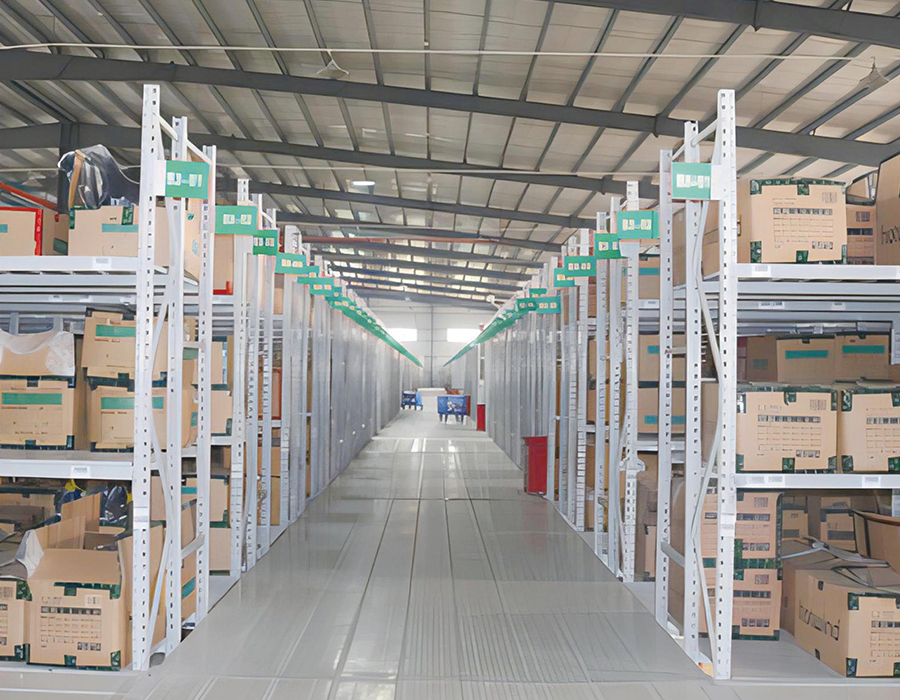
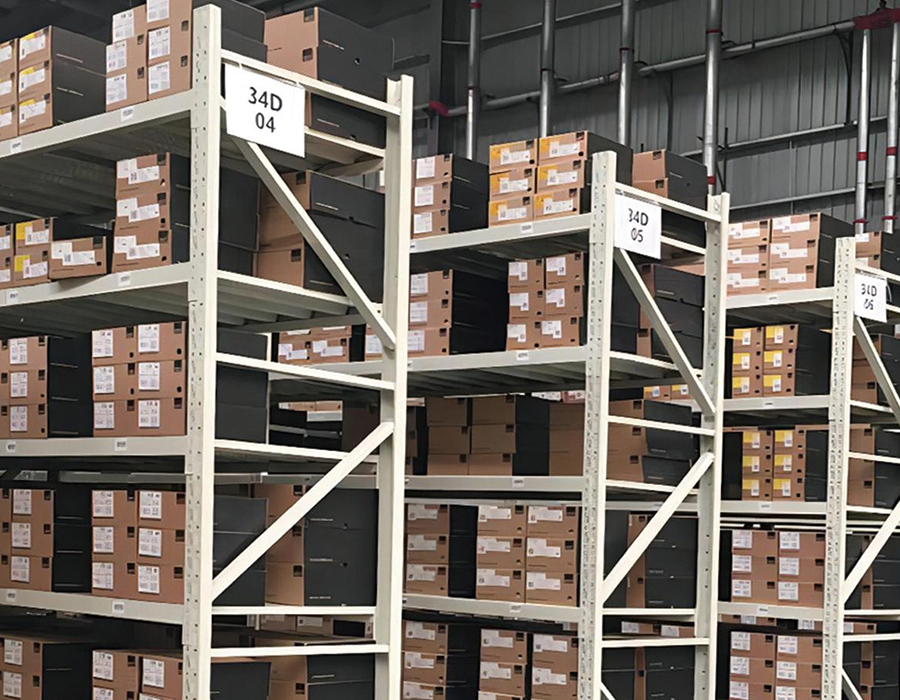
Boltless shelving goes by several names — rivet shelving, slotted-angle shelving, knock-down racking — but the construction is the same idea. Uprights carry keyhole or teardrop slots punched at fixed pitches. Horizontal beams have rivet tabs that drop into those slots and lock as the load settles. Add shelf panels or decking, tie the frames together, and you have a bay. Assembly is a rubber mallet and a spirit level; no welding, no bolts, no installer.
The light-duty version keeps that logic and scales the steel down: thinner beams, lighter uprights, a working rating around 150 kg per layer, and levels that one person can reposition in a couple of minutes. That adjustability is the real selling point. A light-duty bay is not a fixed structure — it is a frame you can replan on a Friday afternoon when the product mix changes.
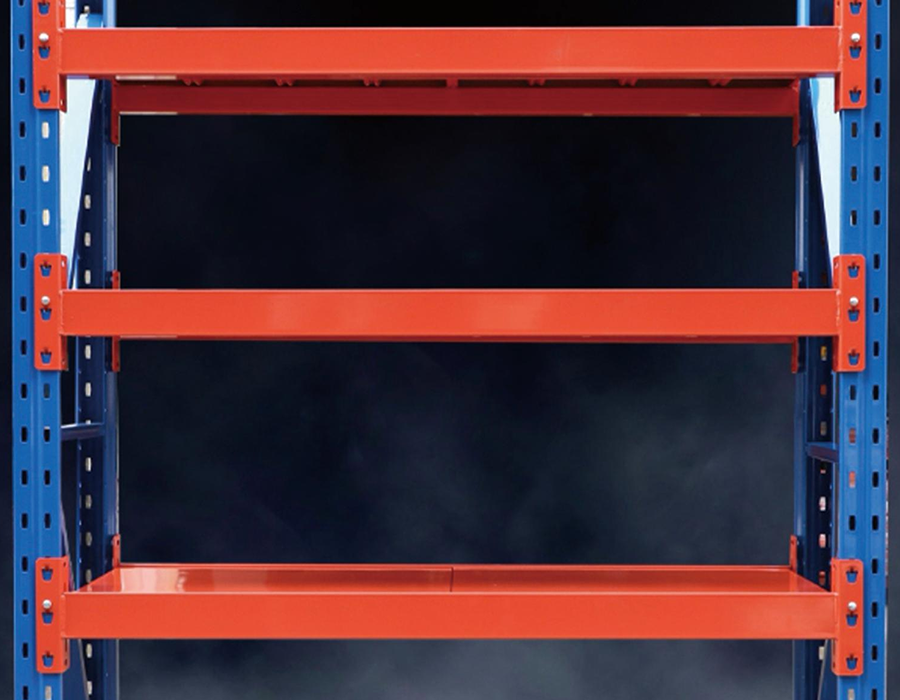 Light-Duty Bolted Steel Shelving SystemA hand-loaded bolted shelving system with repositionable levels, suited to cartons, spare parts, tools and changing light-duty storage needs.View Product →
In our experience the 150 kg tier covers far more real storage than its modest rating suggests, simply because most warehouse and workshop items are not as heavy as people assume:
The common thread is manual handling. Light-duty shelving is designed for a person reaching for a box, not for a forklift placing a pallet. Once your process involves a pallet truck, a stack of drums or anything that has to be lifted mechanically, you have moved into a different product family and should say so up front — it will save a lot of rework.
A published rating is normally a uniformly distributed load per shelf level: weight spread evenly across the whole panel. Drop a 120 kg motor on the middle of a shelf and the panel carries a point load it was never designed for, even though the total is under 150 kg. Heavy items belong over the beam line or directly above an upright, and dense stock should sit low, never on the top level.
Floor condition matters too. A bay is only as level as what it stands on; on old concrete, thin packing plates under the feet make the difference between a frame that sits square for a decade and one that racks itself loose in a season. We go deeper into the arithmetic in our guide to light-duty boltless shelving if you want the longer version.
| Tier | Typical load per layer | Best suited to | Usual access |
|---|---|---|---|
| Light-duty boltless | 150 kg | Cartons, bins, spares, archives | By hand |
| Medium-duty boltless | 500 kg | Denser parts, tools, heavy cartons | By hand or pallet truck |
| Heavy-duty boltless | 800 kg | Castings, drums, bulky assemblies | Pallet truck, some forklift |
| Pallet racking | Pallet-based | Unit loads stored and retrieved by machine | Forklift |
There is a simple tell. If you find yourself calculating whether a shelf will take “just one more” of something, the tier is wrong. Move up to a 500 kg per layer bay and the same footprint carries three times the load with barely any change in how it is used — same mallet, same adjustability, same manual picking. Above that, the 800 kg tier handles drums, castings and dense assemblies, and beyond it pallet racking takes over entirely.
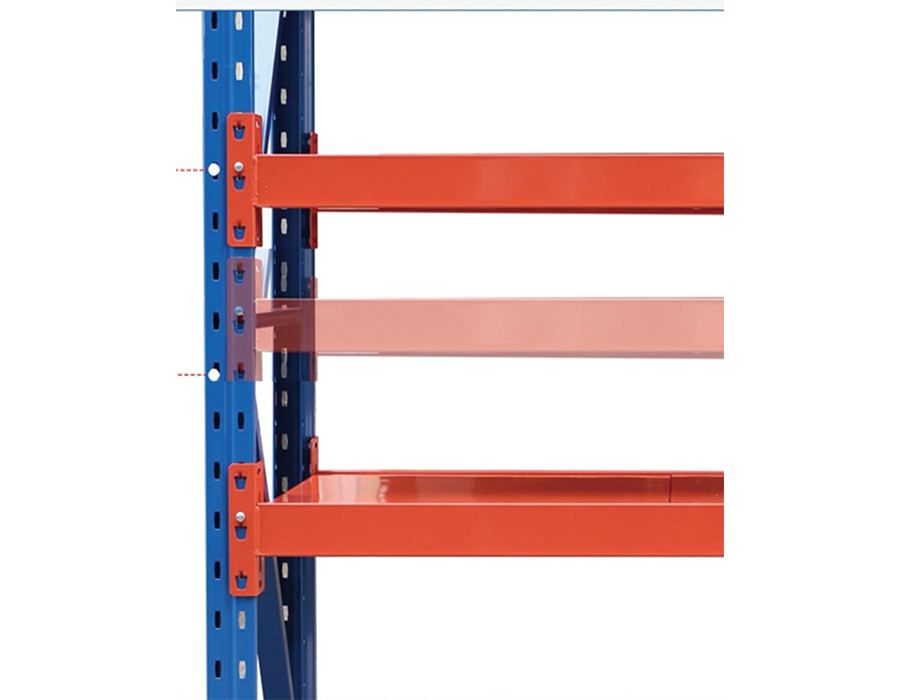 Medium-Duty Bolted Steel ShelvingMedium-duty bolted steel shelving provides adjustable storage for cartons, tools, components and workshop materials. The frame, supports, shelf decks and bracing are s...View Product →
Two people can build a standard bay in well under half an hour. The sequence that keeps frames square is always the same:
Leave the top level for light, bulky items. It is the most convenient place to put things and the worst place to put weight.
Some of the most useful light-duty installations we see are not in a stockroom at all. Line-side bays hold work-in-progress, jigs and consumables within arm's reach of the operator, which shortens walking and keeps benches clear. Where the items are moulds, dies or cutting tools rather than boxes, a drawer unit usually earns its place instead, since drawers keep dust off precision surfaces and let you label by size.
For mixed environments — a workshop that stores both tooling and bulk packaging — it is often worth combining a workshop rack run with a couple of light-duty bays rather than forcing one product to do two jobs.
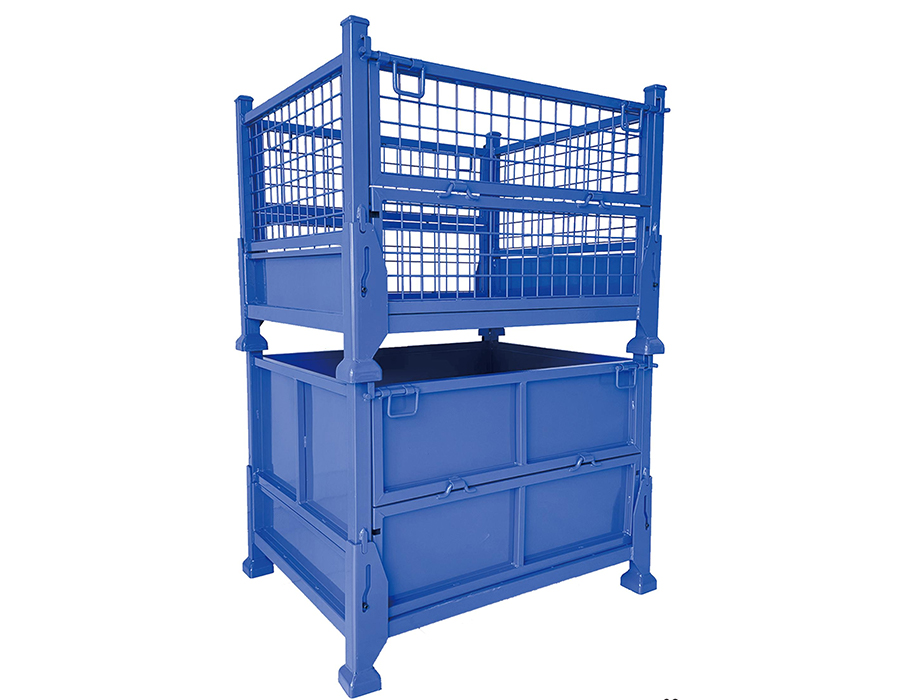 Industrial Workshop Material Racks and Turnover BasketsA range of stackable, foldable racks and forklift-compatible turnover baskets for organized workshop storage and material flow.View Product →
Our manufacturing base in Guangde covers 58,000 m² of factory space with six production lines and a 1,500 m² R&D centre, which is where the beam profiles and slot geometry get worked out before anything reaches the line. Quality control follows the ISO 9001:2015 framework in three stages: incoming raw material inspection, checks at each production step, and a final inspection before dispatch. You can read more about the setup on our factory page.
None of that replaces the basic discipline of matching the rating to the job. A 150 kg bay used within its limits will last for years; the same bay used as a pallet stand will not, and no amount of inspection changes that.
If you are planning a stockroom, a spare-parts area or a line-side installation and you are not certain which tier fits, describe the items and how often they are handled — that is usually enough for us to point you at the right frame rather than the biggest one. Light-duty boltless shelving is a genuinely forgiving product when it is specified honestly, and that is the whole trick.
Our Professional Team
Is Ready to Support You.


 Warehouse Storage Racks Manufacturers






 English
 Español