 2026.06.03
 Industry News
When a warehouse runs heavy loads, operates in demanding environments, or needs to stack product several tiers high without racking, stackable steel pallets solve problems that wood and plastic simply cannot. They carry more weight, survive more cycles, and hold their geometry through conditions that would destroy a wooden pallet in a matter of months. But not all steel pallets are built the same way, and buying the wrong specification — or choosing steel when another material would serve better — wastes capital and creates operational friction. This guide breaks down how stackable steel pallets work, what to look for in the specifications, how they compare to alternatives, and where they genuinely earn their higher upfront cost.
Content
A stackable steel pallet is a rigid platform fabricated from steel — typically Q235 carbon steel or equivalent — with an integrated frame or corner post structure that allows loaded units to be stacked directly on top of one another without racking. The stacking posts or frame elements transfer the weight of upper pallets down through the corner structure rather than through the goods themselves, which means the load on any given pallet is not crushed by the weight above it. This is the defining functional advantage that separates a true stackable steel pallet from a standard flat pallet used in a conventional racking system.
The stacking system replaces or supplements conventional shelving in applications where fixed racking is impractical, where goods are too heavy or irregularly shaped for standard beam configurations, or where the volume of product in storage fluctuates enough that fixed rack positions would be frequently empty. Instead, each loaded pallet becomes its own storage unit — stacked two to five tiers high depending on design load ratings and the weight of the stored goods. This approach can increase effective floor space utilization by 100 to 200% in high-ceiling warehouses without the capital cost of installing additional racking infrastructure.
Most stackable metal pallets are designed for four-way forklift entry, accepting both counterbalance forklifts and pallet jacks from any side. This flexibility makes them compatible with the material handling equipment already in use in most industrial facilities and eliminates the aisle-width constraints associated with narrow-aisle racking systems.
The term "stackable steel pallet" covers several distinct designs that behave differently in operation. Choosing the wrong type for your application creates practical problems that are not obvious from catalog descriptions alone.
Fixed corner post designs weld vertical posts permanently at each corner of the pallet deck. The posts are precisely machined or profiled to nest into corresponding receptacles on the deck below, creating a stable, self-locating stack. These are the most structurally rigid type — suited for the heaviest loads and for high-stack configurations where stability under forklift movement is critical. The fixed post design offers no storage-space advantage when the pallets are empty, since empty units cannot be collapsed or nested. Facilities that return large volumes of empty pallets need to account for the floor space or external storage required to hold empties between cycles.
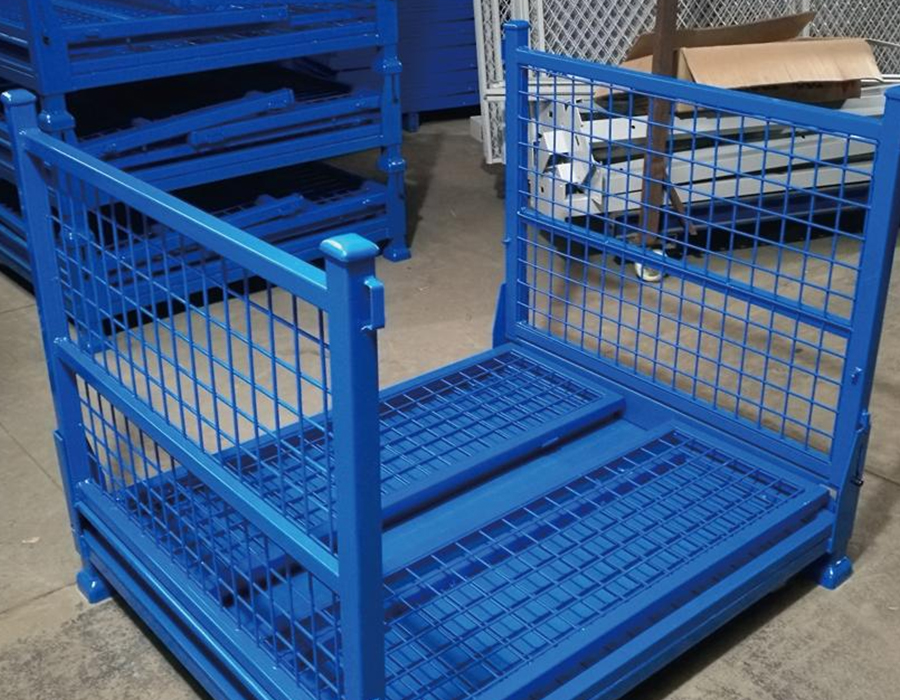
Collapsible steel pallets use hinged or removable corner posts that fold flat when the pallet is empty. An empty collapsible pallet typically reduces to 200–300mm in height, compared to 1,200–1,500mm for a fully erect fixed-post unit. For operations with significant return freight volume or tight empty-storage constraints, this return-space efficiency can represent meaningful logistics cost savings. The trade-off is that the folding mechanism introduces a potential failure point under heavy repeated use — the hinge quality and locking mechanism design are critical specifications to evaluate, particularly for pallets that will be erected and collapsed multiple times per week.
Bolted frame designs connect the stacking structure to the pallet deck using bolts and brackets rather than welding. This makes them easier to field-repair if a post is damaged — a replacement post can be installed on-site without welding equipment. The bolted connection is generally less rigid than a welded joint under lateral loading, making bolted frame pallets better suited to stable, low-vibration storage environments than to high-throughput industrial handling with frequent forklift movement.
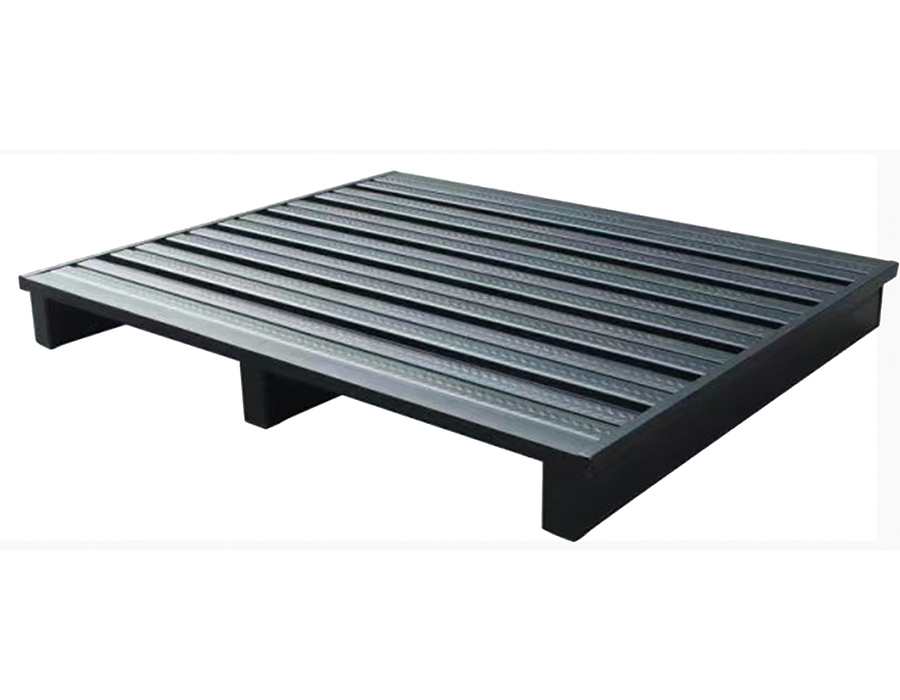
Flat steel pallets without corner posts are designed for use in conventional pallet racking systems rather than direct floor stacking. They are not stackable in the floor-storage sense — they are rackable. These are often galvanized and specified for environments where wooden pallets are prohibited, such as cleanrooms, food-grade cold storage, and pharmaceutical warehouses. Understanding this distinction prevents a common purchasing error where buyers specify "stackable steel pallets" but actually need a rackable flat pallet for use in an existing racking system.
Load capacity specifications for steel stacking pallets are more complex than for standard flat pallets, because three distinct load conditions apply — and each one produces a different rating for the same product.
| Load Type | Definition | Typical Range (Steel) | Key Consideration |
| Static Floor Load | Max weight the pallet can support when stationary on a flat floor | 3,000–8,000+ lbs (1,400–3,600+ kg) | Highest of the three ratings — applies only when the pallet is not being moved |
| Dynamic (Fork) Load | Max weight during forklift handling — lifting, traveling, lowering | 1,500–4,500 lbs (700–2,000 kg) | Typically 40–60% of static rating; governs practical day-to-day handling weight limit |
| Stacked Load | Max cumulative weight the post structure can support from pallets stacked above | 1,000–4,000 kg per pallet depending on post gauge and height | Determines how many loaded tiers can be safely stacked; must account for the weight of all upper pallets combined |
The stacked load rating is the specification most frequently misapplied. If a pallet is rated at 2,000 kg stacked load and you stack three loaded pallets on top of it — each weighing 1,500 kg — the bottom pallet is supporting 4,500 kg in stacked loading, more than double its rated capacity. The correct approach is to divide the total stacked weight across all tiers and verify that no single pallet position — particularly the bottom unit — exceeds the stacked load rating. For applications where full loads will be stacked three or more units high, always specify the stacked load rating first and work backward to select the appropriate product, rather than selecting on price and verifying stacking capacity as an afterthought.
Steel gauge (thickness) directly determines all three load ratings. Most industrial-grade stackable steel pallets use sheet steel between 1 mm and 3 mm thick, with heavier-duty posts constructed from thicker profiles. Specifying gauge explicitly — rather than relying on "heavy duty" product labeling — removes ambiguity and allows direct comparison between suppliers.
The decision between stackable steel pallets and alternatives is fundamentally an economic and operational one, not a question of which material is inherently superior. Each option makes sense in specific contexts.
| Factor | Stackable Steel | Wood Pallet | Plastic Pallet |
| Upfront Cost | High ($150–$600+ per unit) | Low ($10–$30) | Medium ($40–$120) |
| Service Life | 10–20+ years with maintenance | 1–3 years | 8–15 years |
| Load Capacity | Highest — 1,000–4,000+ kg | Moderate — 1,000–2,500 kg standard | Moderate — 1,000–2,000 kg typical |
| Stacking Without Racking | Yes — by design | No (loads would crush goods) | Limited (nestable designs only) |
| Moisture Resistance | Good (coated) / Excellent (galvanized) | Poor — absorbs water, warps, harbors bacteria | Excellent — non-porous |
| Hygiene / Cleanability | Good — non-porous smooth surface | Poor — porous, difficult to sanitize | Excellent — wash-down compatible |
| Pest / ISPM 15 Risk | None | High — requires treatment for export | None |
| End-of-Life Recyclability | 100% recyclable scrap steel | Recyclable / biodegradable | Recyclable (varies by material) |
| Best Application Fit | Heavy industrial, automotive, metals, cold storage, closed-loop | One-way shipment, low-cost supply chains | Food, pharma, ASRS automation, export |
The total cost of ownership calculation consistently favors steel for operations that run closed-loop logistics — where pallets are returned and reused rather than disposed of at the point of delivery. A wooden pallet replaced three times per year at $20 per unit costs $60 annually per pallet position. A steel stackable pallet at $300 upfront, depreciated over 15 years, costs $20 annually. When the cost of labor involved in replacing and disposing of damaged wooden pallets is included, the crossover point where steel becomes cheaper occurs even sooner — typically within two to four years of purchase for high-cycle industrial applications.
Stackable steel pallets are not the right choice for every operation — but for the right applications, they are the only choice that makes structural and economic sense.
Stackable steel pallet specifications vary significantly between manufacturers, and the differences that matter most are not always highlighted in product listings. The following checklist covers the parameters that determine whether a product will perform as expected in your specific operation.
The service life advantage of stackable steel pallets — 10 to 20 years versus 1 to 3 years for wood — depends on a basic maintenance program being implemented and followed. Without it, steel pallets accumulate damage that goes unrepaired and becomes a safety issue rather than a competitive advantage.
Implement a formal inspection cycle, ideally quarterly for high-cycle pallets and biannually for lower-throughput units. Inspections should check for post deformation (bending exceeding 5mm from vertical warrants immediate removal from service), weld cracking at deck-to-post joints, surface coating damage that exposes bare steel to corrosion, and fork pocket wear that could cause pallet instability during handling. Minor weld repairs and recoating of damaged areas can be performed in-house or by qualified repair contractors, extending the service life of a pallet that would otherwise need premature replacement.
At end of life — which for a well-maintained steel pallet typically means structural damage beyond cost-effective repair — the material retains scrap steel value. Steel is 100% recyclable without quality degradation, and scrap recovery offsets a portion of the original purchase cost. This recyclability is a genuine sustainability advantage over plastic pallets, which require specific recycling infrastructure to recover, and over wooden pallets, which in practice are frequently landfilled rather than recycled at the end of their usable life.
Stackable steel pallets are a long-cycle capital investment that pays off when the application genuinely demands what they deliver: high stacked load capacity, rackless vertical storage, sustained performance in harsh environments, and a service life measured in decades rather than years. For the right operations — automotive, metals, cold storage, heavy industrial manufacturing, and closed-loop logistics — they consistently produce a lower total cost of ownership than the alternatives despite the higher upfront unit price.
The key to getting full value is specifying correctly from the start. Use the three-load-rating framework to verify that the static, dynamic, and stacked capacity all match your operational requirements. Confirm steel grade, sheet gauge, forklift entry configuration, and surface finish against your actual environment. And establish a maintenance inspection cycle from day one — because the service life advantage that makes steel pallets economically superior only materializes when damage is identified and repaired before it becomes irreversible.
Our Professional Team
Is Ready to Support You.


 Warehouse Storage Racks Manufacturers




 English
 Español